

We know what’s coming and we are prepared.

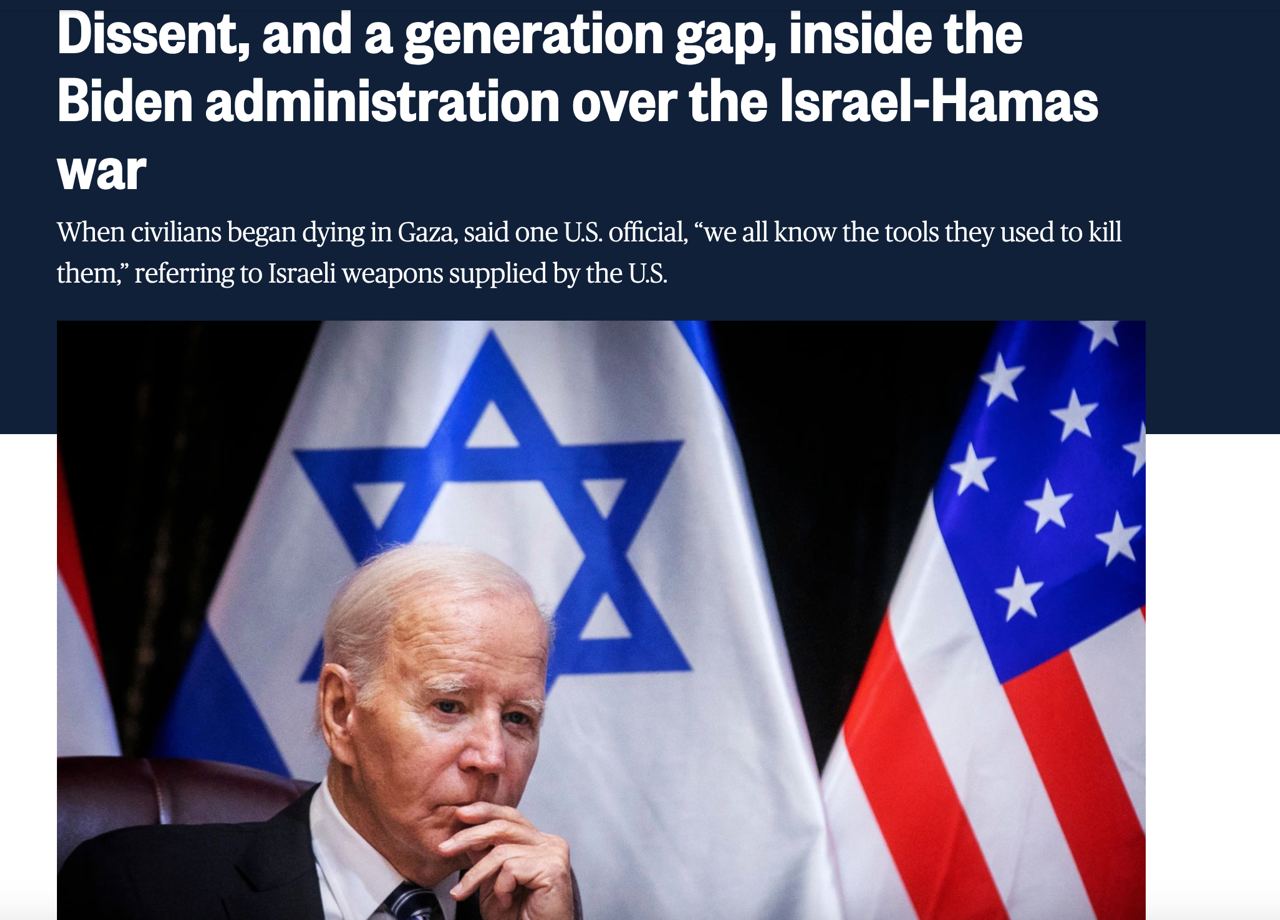
Biden administration is facing growing internal dissent over its support for Israel’s military assault on Hamas in Gaza, reflecting a wider debate in American society and a generational divide among Democrats over the issue, NBC reports.
The extraordinary scope of the dissent inside the government, including statements in open letters from government employees, goes beyond anything seen in previous administrations dating back to the 1980s, including during the Iraq War and President Donald Trump’s restrictions on travel from mainly Muslim states, former officials said.
“It’s remarkable and it’s unprecedented,” said Aaron David Miller, a senior fellow at the Carnegie Endowment for International Peace think tank who worked at the State Department from 1978 to 2003.
“I’ve never seen anything like it.”
The administration is now having to mediate its own internal version of the Israeli-Palestinian conflict, Miller said.
There is a feeling that Israel should not be able to act with “impunity,” the official said, and many foreign service officers believe that with the high civilian death toll in Gaza, U.S. aid to Israel should not remain unconditional, the official said.
U.S. diplomats in the Middle East are sending emails back to Washington saying their most levelheaded counterparts in the region are warning them that America’s reputation is being seriously damaged by its approach to the war, according to two State Department officials.
🇺🇸 Teenagers are now facing charges after doing a ding-dong ditch prank with a twist. They showed up in masks, wearing tactical gear and a rifle, or what looks like a rifle.
Two #Delaware teenagers, aged 16 and 17, faced charges after knocking on doors in New Castle while wearing tactical-style vests and carrying what appeared to be a rifle, police said.
This could’ve ended so badly..
Follow main channel -> LiveLeak
Follow private channel -> LiveLeak Private

🌆 Market News Digest
[Oct 20, 2026 EST]
🔥 Top Stories
• US–Iran tensions swing markets — Hormuz tanker fire, Israel warns of renewed strikes, Rubio says talks are hard; oil stayed volatile even as Brent eased below $109
• Anthropic’s massive AI spend shock — WSJ says it may spend >$600B on compute, with huge cloud/Nvidia commitments and >$80B H1 loss
• Trump on Ukraine, Iran and trade — says Ukraine must make a deal, India trade is “pretty close,” and he’s weighing Iran action
⛽ Oil & Energy
• Hormuz tanker fire / mine incident — IRGC says a supertanker carrying >2M barrels caught fire after hitting a mine
• Europe gas >€90 — benchmark tops 2022 levels on supply fears; US diesel prices remain elevated
• NATO and EU security push — NATO adds Black Sea assets; EU doubles down on Arctic security and keeping fossil fuels in the ground
📊 Markets & Macro
• US housing weakens further — starts fell 5.2% and pending sales dropped 7.3% to a record low, pressuring ...
📝 🇪🇺 🇫🇷 Mario Nawfal on X: Europe's riots are just the beginning. The real economic shock hasn't even arrived yet.
I spoke with economist Philip Pilkington about the unrest spreading across France, Italy and Albania.
He thinks we're watching the early stages of something much bigger.
One statistic really caught my attention.
According to Pilkington, France's inflation-adjusted household food consumption has fallen roughly 6.4% since 2022. He suspects the poorest households have suffered far steeper cuts.
Now add another surge in energy prices.
Pilkington pointed to rice futures rising 70% this year, wheat and sugar climbing 40%, and fertilizer shortages threatening next year's harvest.
His prediction is that the worst food inflation could arrive this winter or next spring.
And there's a political problem sitting right on top of it.
Governments across Europe are already deeply unpopular. People are struggling to afford basic necessities, and another prolonged energy ...