

We know what’s coming and we are prepared.

🌕 🇺🇸 🇨🇳 Why is there so much military interest in the moon?
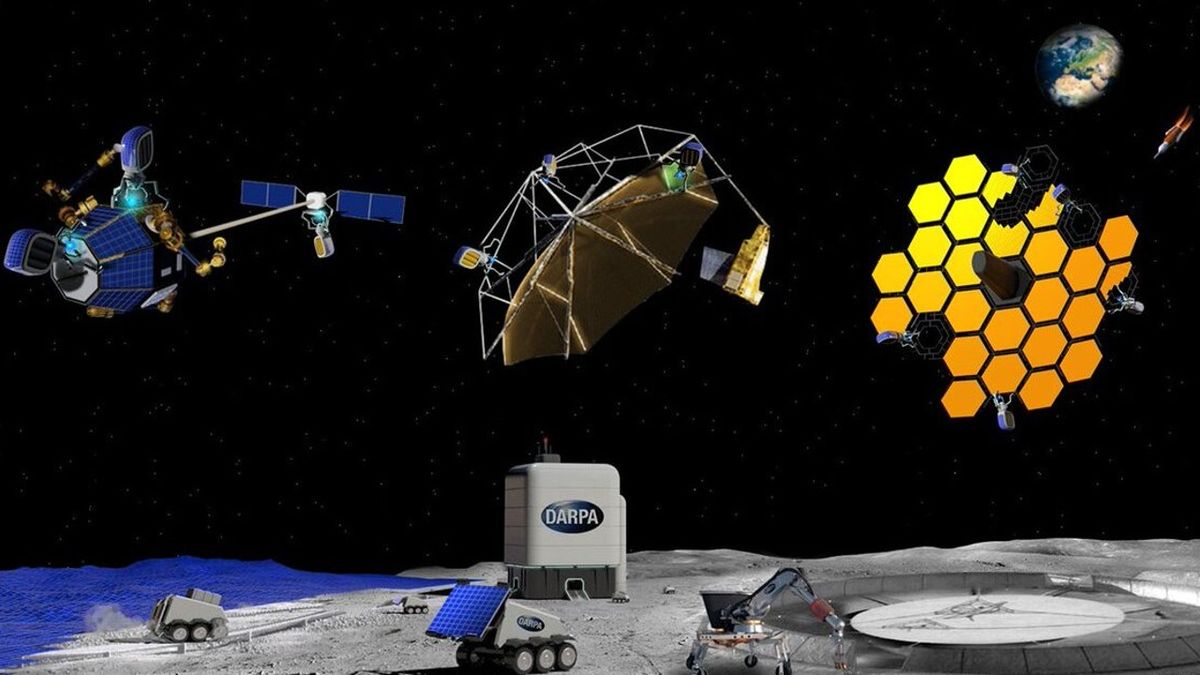
🔶️ A trio of proactive DARPA undertakings looking to advance technologies for use on the moon has been welcomed in some quarters. Back in 2021, DARPA kick-started its Novel Orbital moon Manufacturing, Materials, and Mass Efficient Design (NOM4D) program. Last month, DARPA threw in some "LOGIC" into the mix via the Lunar Operating Guidelines for Infrastructure Consortium, or LOGIC for short. DARPA has also initiated the 10-Year Lunar Architecture (LunA-10) Capability Study to spur the development of an integrated future lunar infrastructure for "peaceful U.S. and international use."
🔶️ Beijing is working to establish a long-term presence in space, "which it seeks to accomplish by first dominating the cislunar domain" - the space between Earth and the moon.
Noted by the Commission is U.S. military belief that cislunar space is an important domain, one that allows the United States to place its national security space assets beyond low-Earth orbit and geosynchronous orbit and to establish infrastructure that will enable long-term presence on the moon and elsewhere.
🔶️ In the 1970's NASA asked the Air Force if they wanted a base on the moon, and they said no, Szymanski told Space.com. "Yet now, I personally know of companies planning on providing cell phone service on the moon and the Air Force Research Lab is developing several programs, such as space surveillance for the far side of the moon. None of this makes sense, unless there is some other not publicly known factor that has changed everyone's attitudes."
🔶️ Szymanski said he theorizes that China will abrogate the 1967 Outer Space Treaty just before landing their first astronauts on the moon.
🔶️ "They will then declare ownership of the entire moon, like the Pope did centuries ago declaring Spain and Portugal owned the entire Western hemisphere. Good luck defending all of that!"
📢 🇬🇧 🥫 Britain has urged households to stock enough water, non-perishable food and medicine to be self-sufficient for three days, launching a new “Be Ready” preparedness campaign.
Government guidance recommends about three liters of drinking water per person per day, food that needs no refrigeration or cooking, essential medications, a first-aid kit, a torch, a battery or wind-up radio, a charged power bank and cash.
Officials cited severe storms, wildfires, cyberattacks and supply chain disruptions as the main risks, with Defence Secretary Wes Streeting pointing to “increasingly sophisticated cyber attacks” and scenarios such as supermarket payment systems going down.
Germany has long gone further, recommending households keep emergency supplies for 10 days, including about two liters of liquid per person per day.
📝 ReadyGuidance: "Worth noting the US version of this advice, at Ready.gov, is one gallon of water per person per day, about 3.8 liters, because ...
🇮🇹 Italy Experiences Food and Fuel Shortages After Truckers on Strike Block Roads. 90% of gas stations in Campania are out of fuel
Truckers protesting high gas prices have prevented deliveries to parts of southern Italy, leading to empty shelves and dry pumps.
On Wednesday night in Naples, Italy, a 72-year-old retiree walked into a supermarket to buy himself a snack and found it nearly bare.
It was out of milk, yogurt and eggs. Its shelves of pasta, oils and canned tomatoes were almost empty. The vast produce section was empty save for red onions, chestnuts, two melons and a case of ornamental gourds.
“It’s worse than I expected,” said Giuseppe Crisci, the retiree, who walked out with a bag of biscuits. “And what I expected was exceptional.”
Experiences like Mr. Crisci’s played out repeatedly this week across Naples, a sprawling port city in Italy’s south where residents faced widespread shortages at their gas pumps and grocery stores.
It is the fallout from a week of...
🇺🇸🗳⚡️- RN's Midterm Forecast With A Week And A Half To Go 3/3:
Why we think this election will be the first real nail in the coffin for Trumpism.
It has been said so many times it's become a meme, “the walls are closing in” “No way he wiggles out of this jam!” etc. This time it's not a joke, the armor that Trump has had around him for a decade is clearly slipping off.
Trump’s approval by his own 2024 voters continues to rapidly decline, damaged by the nonstop rampant corruption and the Iran War.
Trump approval within the GOP, despite remaining strong on paper, is actually at its lowest since 2015 before he won the 2016 primary. The Iran War in particular has nuked his bedrock fanatical support within the GOP base when looking at not only surveys but also via multiple anecdotes on AM radio talk shows who get callers every day saying they feel betrayed by the war, and that the corruption is becoming unignorable.
GOP activists at the local level are also reporting to their ...