

We know what’s coming and we are prepared.

Oil and Water
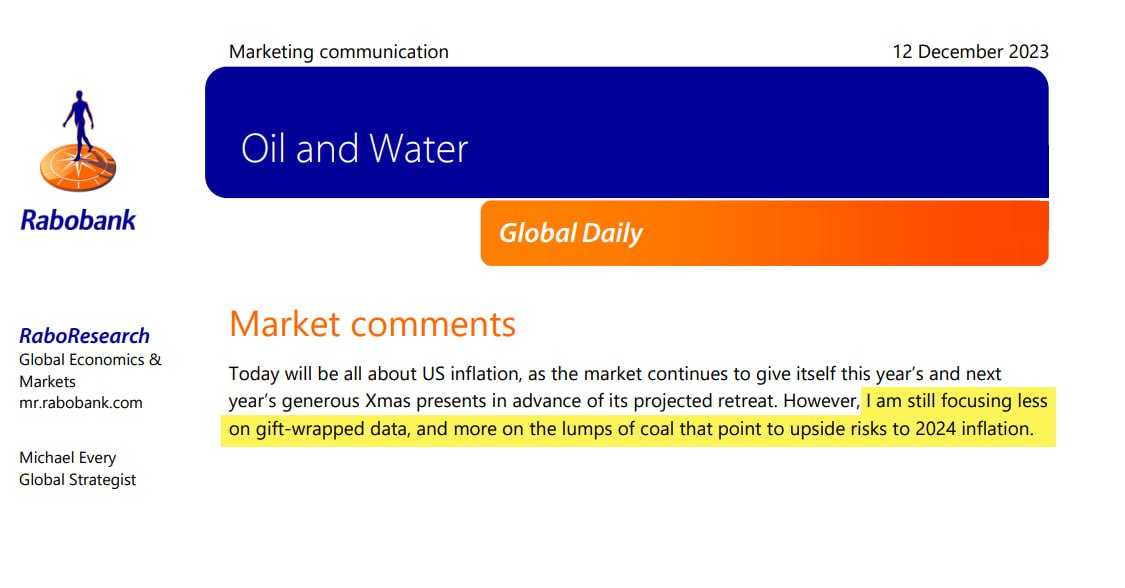
Rabobank Global Strategist Michael Every began a Tuesday note aptly named "Oil and Water" by acknowledging the value of "oil and water (routes)" in an inflationary, multipolar world: "Especially as Yemen’s Houthis have attacked ships carrying cargo via the Red Sea or Arabian Gulf. Welcome to how the world used to work before British, then US, naval supremacy. This is what a multipolar world is going to look like..."
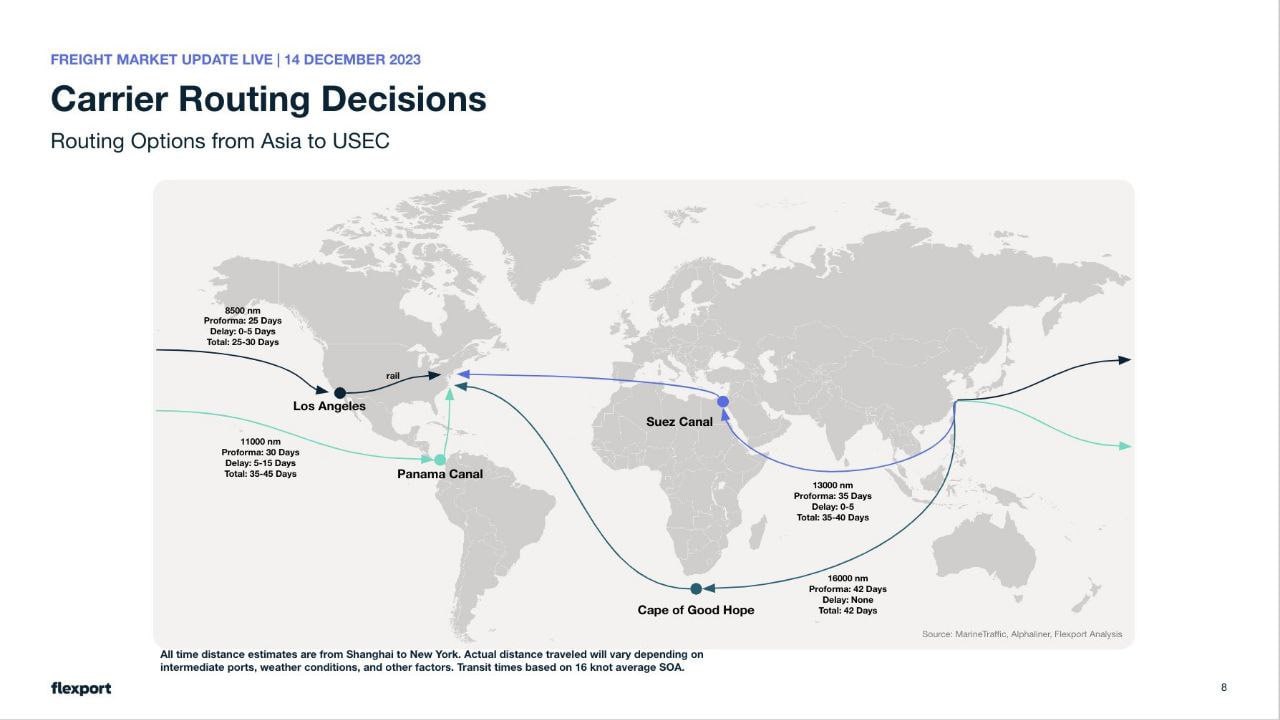
Michael Every laments that it’s only reactive to attacks on shipping, not proactive at the source: "That maintains the risk for more shipping to divert from Suez round the Cape of Good Hope: if so, global carriers would only be able to make 3-4 Asia-Europe roundtrips per year, not 4-5, a massive structural drop in supply capacity. The Financial Times warns , including the drought in Panama cutting passages there and geopolitical risk threatening the Suez."
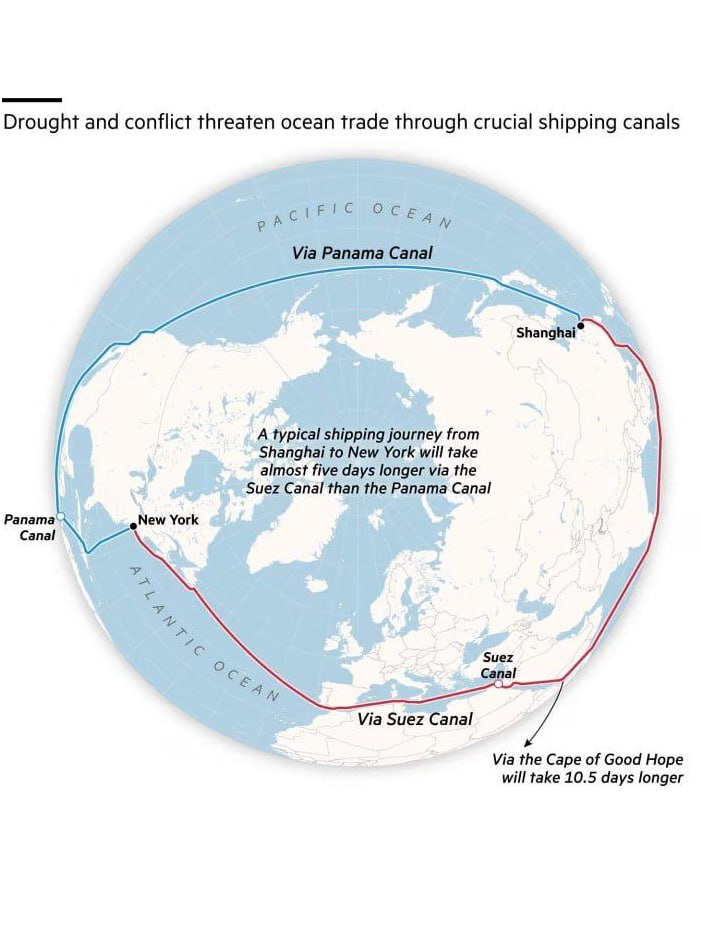
The Rabobank report appropriately followed an article out of the FT titled ‘Global pre-Christmas trade at risk from twin canal crises’, which warned of a synergistic supply shock from both the Panama drought and, of course, ongoing geopolitical risks near the Suez.
The FT notes that "Switching routes from Panama to Suez adds five days to journeys between New York and Shanghai... If more shipowners avoid the Suez Canal and take the long route around Africa’s Cape of Good Hope for journeys between the same cities, this could add an additional six days to their journey."
At least 167 ships crossed the canal during the first week of December this year, compared with 238 last year. Authorities have for the first time reduced the number of crossings, which by February will be limited to only 18 ships a day.
Multiple shipowners have already applied surcharges of hundreds of dollars per container for exporters sending goods through Panama, as the cost of using the canal increased by up to millions of dollars per ship passage. Hapag-Lloyd announced an upcoming “war risk surcharge” of up to $80 for all shipments to and from Israel.
🇺🇸 Teenagers are now facing charges after doing a ding-dong ditch prank with a twist. They showed up in masks, wearing tactical gear and a rifle, or what looks like a rifle.
Two #Delaware teenagers, aged 16 and 17, faced charges after knocking on doors in New Castle while wearing tactical-style vests and carrying what appeared to be a rifle, police said.
This could’ve ended so badly..
Follow main channel -> LiveLeak
Follow private channel -> LiveLeak Private

🌆 Market News Digest
[Oct 20, 2026 EST]
🔥 Top Stories
• US–Iran tensions swing markets — Hormuz tanker fire, Israel warns of renewed strikes, Rubio says talks are hard; oil stayed volatile even as Brent eased below $109
• Anthropic’s massive AI spend shock — WSJ says it may spend >$600B on compute, with huge cloud/Nvidia commitments and >$80B H1 loss
• Trump on Ukraine, Iran and trade — says Ukraine must make a deal, India trade is “pretty close,” and he’s weighing Iran action
⛽ Oil & Energy
• Hormuz tanker fire / mine incident — IRGC says a supertanker carrying >2M barrels caught fire after hitting a mine
• Europe gas >€90 — benchmark tops 2022 levels on supply fears; US diesel prices remain elevated
• NATO and EU security push — NATO adds Black Sea assets; EU doubles down on Arctic security and keeping fossil fuels in the ground
📊 Markets & Macro
• US housing weakens further — starts fell 5.2% and pending sales dropped 7.3% to a record low, pressuring ...
📝 🇪🇺 🇫🇷 Mario Nawfal on X: Europe's riots are just the beginning. The real economic shock hasn't even arrived yet.
I spoke with economist Philip Pilkington about the unrest spreading across France, Italy and Albania.
He thinks we're watching the early stages of something much bigger.
One statistic really caught my attention.
According to Pilkington, France's inflation-adjusted household food consumption has fallen roughly 6.4% since 2022. He suspects the poorest households have suffered far steeper cuts.
Now add another surge in energy prices.
Pilkington pointed to rice futures rising 70% this year, wheat and sugar climbing 40%, and fertilizer shortages threatening next year's harvest.
His prediction is that the worst food inflation could arrive this winter or next spring.
And there's a political problem sitting right on top of it.
Governments across Europe are already deeply unpopular. People are struggling to afford basic necessities, and another prolonged energy ...