

We know what’s coming and we are prepared.

Intercept Exclusive: Israeli Military Censor Bans Reporting on These 8 Subjects
The highly unusual, English-language order for the Gaza war breaks from the secretive and informal way IDF censorship normally works.
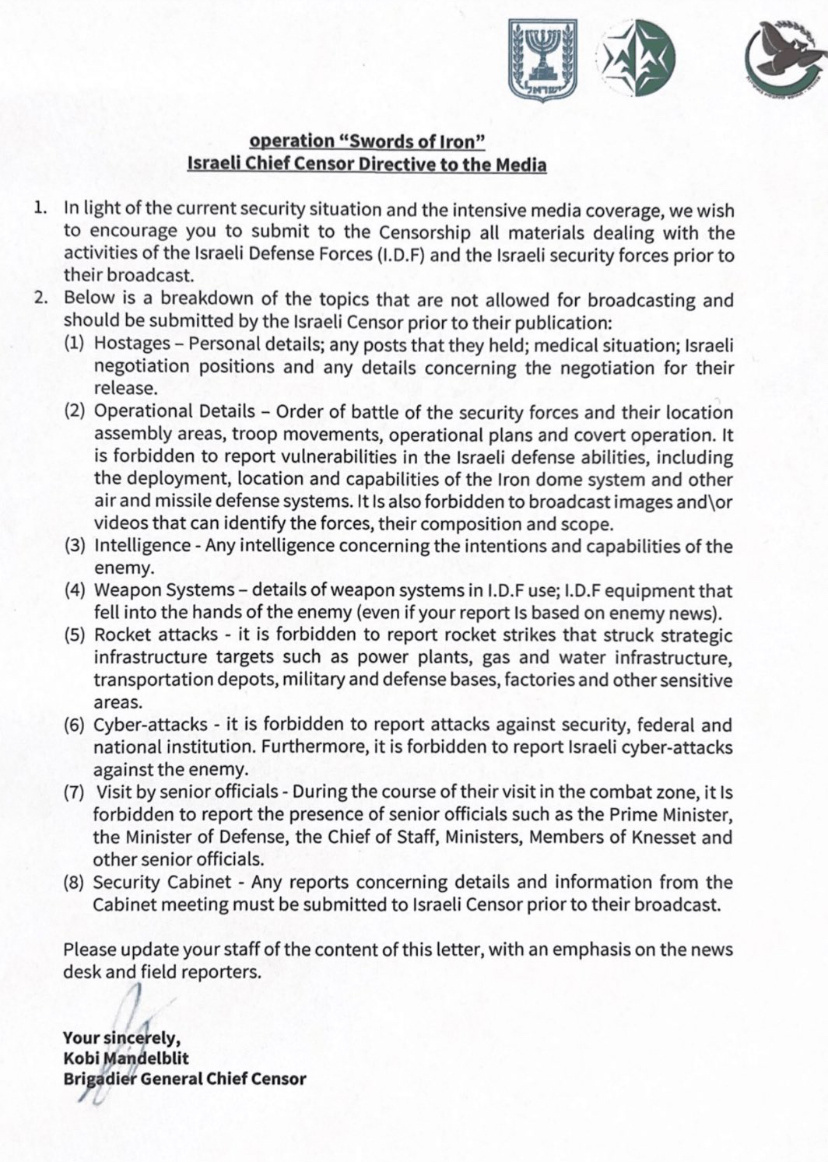
Weapons the Israel Defense Forces, security cabinet leaks, and stories about people held hostage by Hamas — these are some of the eight subjects the media are forbidden from reporting in Israel, according to a document obtained by The Intercept.
The document, a censorship order issued by the Israeli military to the media as part of its war on Hamas, has not been previously reported. The memo, written in English, was an unusual move for the IDF’s censor, which has been part of the Israel military for more than seven decades.
“I haven’t ever seen instructions like this sent from the censor aside from general notices broadly telling outlets to comply, and even then it was only sent to certain people,” said Michael Omer-Man, a former editor-in-chief of the Israel’s +972 Magazine and today the director of research for Israel–Palestine at Democracy in the Arab World Now, or DAWN, a U.S. advocacy group.
Titled “Operation ‘Swords of Iron’ Israeli Chief Censor Directive to the Media,” the order is not dated, but its reference to Operation Swords of Iron — the name of Israel’s current military operation in Gaza — makes clear that it was issued sometime after Hamas’s October 7 attack on Israel. The order is signed by the chief censor of the Israel Defense Forces, Brig. Gen. Kobi Mandelblit. (The Israeli Military Censor did not respond to a request for comment on the memo.)
The document was provided to The Intercept by a source who himself was given a copy by the Israeli military. An identical document appears onOpens in a new tab the Israeli government’s website.
“In light of the current security situation and the intensive media coverage, we wish to encourage you to submit to the Censorship all materials dealing with the activities of the Israeli Defense Forces (I.D.F.) and the Israeli security forces prior to their broadcast,” the order says. “Please update your staff of the content of this letter, with an emphasis on the news desk and field reporters.”
🔗Source: The Intercept, Ken Klippenstein
🇲🇽- Mexican Cartel Drone Operator seen stalking a Mexican Marine Convoy in Mazatlán.
This isn’t much of a surprise, Cartel members have reportedly been joining the Ukrainian Foreign Legions en masse to hone drone operation and close quarters combat skills.
Since many of them are starting to return home, and now training other members of their cartels, i wouldn’t be shocked to see a new level of militarization in these organizations.
📝 🇪🇺 🇫🇷 Mario Nawfal on X: Europe's riots are just the beginning. The real economic shock hasn't even arrived yet.
I spoke with economist Philip Pilkington about the unrest spreading across France, Italy and Albania.
He thinks we're watching the early stages of something much bigger.
One statistic really caught my attention.
According to Pilkington, France's inflation-adjusted household food consumption has fallen roughly 6.4% since 2022. He suspects the poorest households have suffered far steeper cuts.
Now add another surge in energy prices.
Pilkington pointed to rice futures rising 70% this year, wheat and sugar climbing 40%, and fertilizer shortages threatening next year's harvest.
His prediction is that the worst food inflation could arrive this winter or next spring.
And there's a political problem sitting right on top of it.
Governments across Europe are already deeply unpopular. People are struggling to afford basic necessities, and another prolonged energy ...
🇨🇦🇨🇦🗳 Alberta votes on leaving Canada; separatist movement likely to outlast expected defeat
Alberta holds a nonbinding referendum on Monday on whether the western province should secede from Canada, a debate many believe will not be settled by what is widely expected to be a defeat for the separatist cause.
Polls have consistently shown that a majority of Alberta voters oppose splitting from Canada. Economic grievances have fueled the independence campaign in the province, which is home to 5 million people and slightly smaller than Texas despite having one-sixth the population.
The Alberta separatist movement adds to the pressures on Canadian Prime Minister Mark Carney, who has made defending Canada's sovereignty a central mission as he confronts US tariffs and President Donald Trump's repeated calls for Canada to become the 51st state.
Many Alberta separatists believe the Liberal Party-led federal government in Ottawa has constrained the Conservative-governed ...
My jaw literally dropped listening to this
There is a Muslim pilot who works for United Airlines that regularly makes pro-terrorist organizations posts on his social media
The Muslims name is Ibrahim Mossallam. He works on the Board of CAIR New York, which is linked to the Muslim Brotherhood
He made an October 7, 2023 Facebook post calling the Hamas attacks “resistance by a brave people.” United suspended him with pay while investigating but the Pilots Union got him his job back and he went back to flying planes in America
Since then the pilot has been temporarily resuspended for flying because of his extreme religious beliefs and posts but he is 100% still employed. He is still getting paid on suspension
I looked into this guy and he is VERY involved in Muslim organizations
- CAIR-NY lists him as Board Vice-President and describes him as a professional international airline pilot who is “very active in shaping the Muslim youth community.”
- He has also been listed as a board ...