

We know what’s coming and we are prepared.

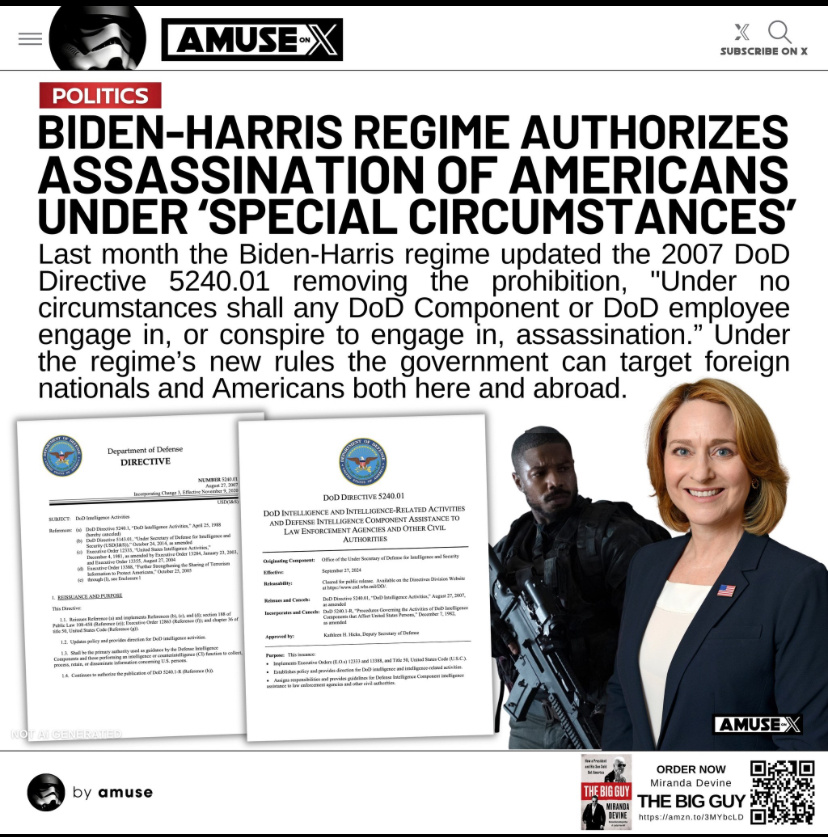
ASSASSIN@TION: With just months left in office the Biden-Harris regime decided to update the 17 year old Bush-era directive against assassin@tion of Americans. Why would the regime feel the need to legalize killing Americans who threaten the foundations of our democracy?
In a chilling and unambiguous act, the Biden-Harris regime has recently updated the 2007 DoD Directive 5240.01, stripping away crucial protections that safeguarded American citizens from government-sanctioned assassin@tions. The original directive contained an explicit prohibition, stating, "Under no circumstances shall any DoD Component or DoD employee engage in, or conspire to engage in, assassin@tion." This unequivocal language has been removed, paving the way for a dangerous new precedent that authorizes the targeting of both American citizens and foreign nationals—both on domestic soil and abroad—under vague and ominous "special circumstances."
This egregious alteration marks a perilous departure from the established norms that have historically protected the civil liberties of U.S. citizens. The notion that the government can now potentially authorize the assassination of Americans under the guise of national security is nothing short of a constitutional crisis. It opens a Pandora's box where the executive branch could circumvent legal processes and judicial oversight, allowing for a chilling expansion of government power and an alarming erosion of individual rights.
The Biden-Harris regime’s willingness to authorize assassin@tion reflects a profound disregard for the sanctity of American lives and the rule of law. It exemplifies a troubling trend toward authoritarianism, where the state’s interests are prioritized over the rights of individuals. By enabling the targeting of U.S. citizens—often without the checks and balances that judicial oversight provides—the regime is setting a dangerous precedent that could lead to abuses of power reminiscent of the darkest chapters in our nation’s history.
Moreover, the implications extend beyond mere policy shifts; they signal a fundamental transformation in the relationship between the government and its citizens. The ability of the state to conduct targeted killings without due process undermines the very foundations of our democratic society, where the rule of law and the protection of individual rights have been paramount. It raises unsettling questions: Who decides what constitutes a "threat"? What criteria are used to determine when such extreme measures are warranted?
This new directive does not merely modify existing procedures; it fundamentally alters the landscape of governmental authority and individual rights in America. As we stand at this critical juncture, we must remain vigilant and resolute in our defense of civil liberties. The implications of the Biden-Harris regime’s actions demand serious reflection and urgent action from all who cherish the freedoms granted to us by our Constitution.
In conclusion, the recent updates to DoD Directive 5240.01 should serve as a clarion call for all Americans. The stripping away of prohibitions against assassin@tion represents not just a policy change, but a grave threat to the very essence of our democratic principles. We must rally together to demand accountability, transparency, and a reaffirmation of the rights that define our great nation. The time to act is now; let us not allow this regime to tread upon the rights of the American people without consequence.
🇺🇸⚔️🇮🇷 US forces in the Middle East are prepared to launch new, potentially major, military operations against Iran “within 96 hours of receiving” an order from President Donald Trump, according to two US officials.
Sufficient forces are now deployed in the region to carry out the potential attacks, the sources said. The scope of new US military operations would likely go beyond efforts to simply “mow the lawn” or maintain the status quo by striking radars, launchers and other Iranian assets that can be quickly reconstituted — as has been the case since Trump halted full combat operations earlier this year, the sources added.
“It will be a big effort,” one of the officials told CNN. That view has been echoed by other current and former US officials familiar with internal military planning discussions — some of whom say it is a question of when, not if, Trump will issue a go-order. They believe it could come any time before the end of the year, though most likely after ...

This is a very good video explaining in detail the damage caused by the arson attack on the Eagle's Nest, and also the systematic destruction, vandalism and insane, hate-filled iconoclasm inflicted on Hitler's beloved Berghof and associated buildings since 1945:
Felton correctly points out the Eagle's Nest was Hitler's least-favorite building there and he only visited it on a handful of occasions (it was more of an extravagant vanity protect by Martin Bormann).
Hitler's favorite building, by far, was the little tea house with the overlook, which he visited daily. This survived the war completely intact, but was needlessly destroyed by the anti-Nazi collaborationist Bavarian government in 1951, for no other reason than it was Hitler's favorite spot.
While I am saddened and angered by the burning of the Eagle's Nest, I imagine Hitler would just shrug after all the other decades of destruction that have been visited on the site, including the original ...
James Comer: Ilhan Omar’s Winery Sold Empty Barrels of Wine to Investors (VIDEO)
https://www.thegatewaypundit.com/2026/10/chairman-comer-ilhan-omars-winery-sold-empty-barrels/