

We know what’s coming and we are prepared.

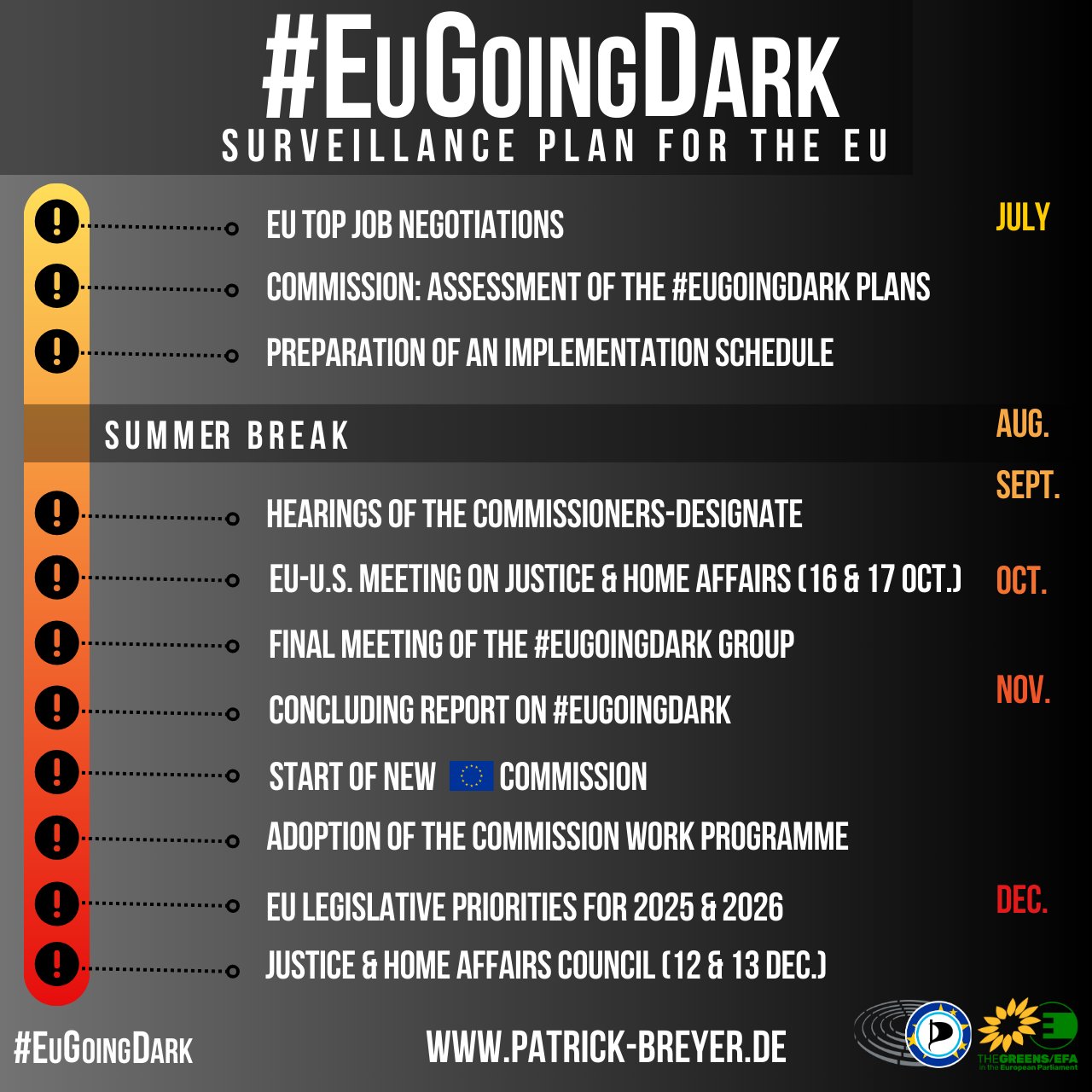
🇪🇺 EuGoingDark surveillance plan: timeline, agenda, background
Highly controversial, non-transparent and rarely questioned: the Commission and Council of the European Union are currently preparing a new, EU-wide digital surveillance package. The plan includes the reintroduction and expansion of the retention of citizens’ communications data as well as specific proposals to undermine the secure encryption of data on all connected devices, ranging from cars to smartphones, as well as data processed by service providers and data in transit.
Behind closed doors the Commission has announced it is already preparing impact assessments and an implementation plan.
Former Pirate Party MEP and digital freedom fighter in the European Parliament Patrick Breyer comments:
“The plan is still widely unknown among citizens, journalists and politicians, even though we hold the documents in our hands and the extent of the plans is frightening. A number of questions remain unanswered.”
Open questions:
Who participated in the meetings of the EuGoingDark group and its sub-groups? Participant lists are still undisclosed. Mullvad VPN has reported that at least one former US secret service official has participated.
Why were digital rights NGOs such as EDRi not invited to the meetings of the working group even when the group‘s website says it is an “collaborative and inclusive platform for stakeholders from all relevant sectors“?
Why aren‘t the group and its sub-groups registered in the Register of Commission Expert Groups and other similar entities (i.e. consultative entities) which would provide for significantly more transparency?
How do the new EU Commissioners directly and indirectly involved in the issues concerned, the European Ombudsman, the data protection authorities of the EU and the member states, IT security experts, consumer protection organisations and others assess the working methods and plans of the EuGoingDark-group?
🔗 https://www.patrick-breyer.de/en/eugoingdark-surveillance-plan-timeline-agenda-background/
NEW - Irish government runs an advert discouraging grandparents from hugging their grandchildren without consent.
@disclosetv
🇺🇸 Teenagers are now facing charges after doing a ding-dong ditch prank with a twist. They showed up in masks, wearing tactical gear and a rifle, or what looks like a rifle.
Two #Delaware teenagers, aged 16 and 17, faced charges after knocking on doors in New Castle while wearing tactical-style vests and carrying what appeared to be a rifle, police said.
This could’ve ended so badly..
Follow main channel -> LiveLeak
Follow private channel -> LiveLeak Private
🌆 Market News Digest
[Oct 21, 2026, 06:00–16:30 EST]
🔥 Top Stories
• Gulf tensions spike as U.S. orders Saudi embassy departures — Houthi drone attacks on Aramco/Shaybah, Iranian rhetoric, and evacuation alerts lifted oil-sensitive geopolitical risk
• Meta beats on revenue, unveils nonvoting stock plan — Q3 sales topped estimates, but a $9.9B legal charge crushed operating income as capex/AI spending stays huge
• OpenAI deepens Google Cloud partnership — Frontier models and Codex go onto Google Cloud Marketplace, a notable distribution win for Google and OpenAI
⛽ Oil & Energy
• Saudi Aramco/Shaybah attacked, but operations intact — air defenses intercepted a drone; no operational impact, yet the event kept crude elevated
• EIA crude stocks fall 3.06M barrels; gasoline drops 2.95M — bigger-than-expected draw, while diesel/distillate built
• WTI settles at $97.15; Brent at $108.82 — oil eased late despite supply fears; Kuwait says exports are at prewar levels
📊 Markets & Macro...

🌆 Market News Digest
[Oct 20, 2026 EST]
🔥 Top Stories
• US–Iran tensions swing markets — Hormuz tanker fire, Israel warns of renewed strikes, Rubio says talks are hard; oil stayed volatile even as Brent eased below $109
• Anthropic’s massive AI spend shock — WSJ says it may spend >$600B on compute, with huge cloud/Nvidia commitments and >$80B H1 loss
• Trump on Ukraine, Iran and trade — says Ukraine must make a deal, India trade is “pretty close,” and he’s weighing Iran action
⛽ Oil & Energy
• Hormuz tanker fire / mine incident — IRGC says a supertanker carrying >2M barrels caught fire after hitting a mine
• Europe gas >€90 — benchmark tops 2022 levels on supply fears; US diesel prices remain elevated
• NATO and EU security push — NATO adds Black Sea assets; EU doubles down on Arctic security and keeping fossil fuels in the ground
📊 Markets & Macro
• US housing weakens further — starts fell 5.2% and pending sales dropped 7.3% to a record low, pressuring ...