

We know what’s coming and we are prepared.

🇺🇸🇪🇺 Donald Trump has shown up the European Union. He’s revealed that the world’s largest single market is a paper tiger to be kicked around, with basically no leverage or strength to resist American demands.
All of these supposedly fierce backroom tariff negotiations have yielded an incredibly one-sided deal – really an unparalleled embarrassment. As announced yesterday, the EU promises to invest $600 billion in the U.S. economy and to make $750 billion worth of “strategic purchases” of oil, gas and the like over the next three years. We also promise to buy a bunch of American military equipment.
In return for giving the Americans $1.35 trillion, we earn the privilege of a 15% baseline tariff on all of our exports to America and we drop our own tariffs to zero. At least we don’t have to pay the 30% tariffs Trump threatened!
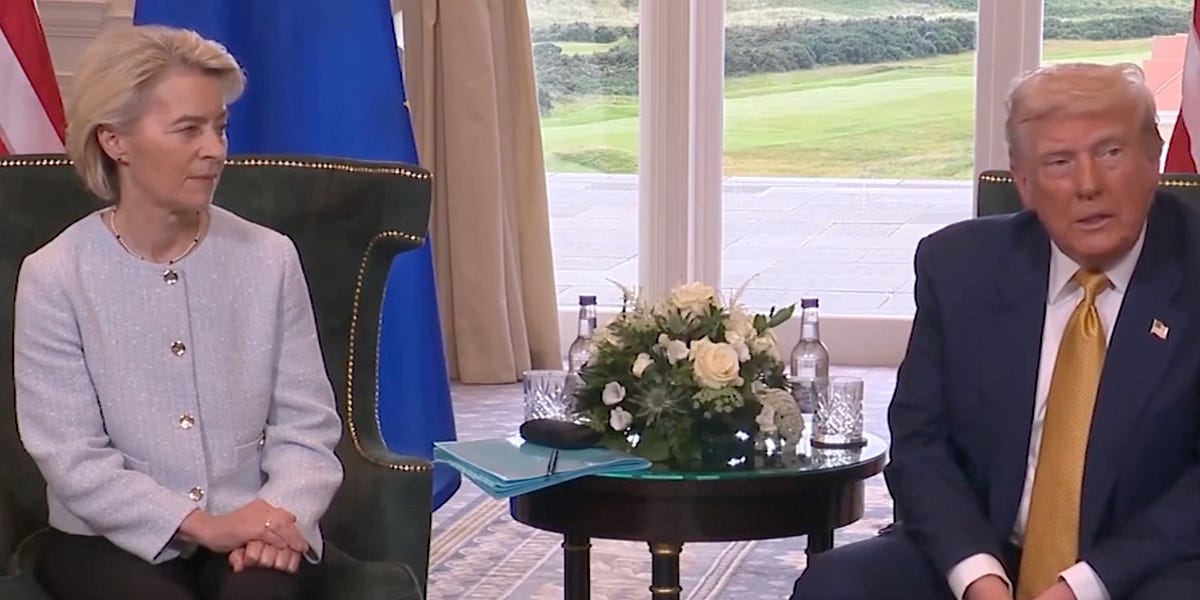
While von der Leyen was trying weakly to put a happy face on her total failure, Trump gave her what we might call a softer Zelensky treatment. He twisted the knife in the wound, calling out the idiocy of EU wind energy in an extended soliloquy that will surely keep the fact-checkers and the regime deboonkers up late for weeks to come. I transcribe his remarks in full, because the whole moment was wonderful:
And the other thing I say to Europe, we will not allow a windmill to be built in the United States. They’re killing us. They’re killing the beauty of our scenery, our valleys, our beautiful plains. And I’m not talking about airplanes. I’m talking about beautiful plains, the beautiful areas in the United States. And you look up and you see windmills all over the place. It’s a horrible thing. It’s the most expensive form of energy. It’s no good.
They’re made in China, almost all of them. When they start to rust and rot in eight years, you can’t really turn them off. You can’t bury them. They won’t let you bury the propellers, you know, the props, because they’re a certain type of fiber that doesn’t go well with the land. That’s what they say. The environmentalists say you can’t bury them because the fiber doesn’t go well with the land. In other words, if you bury it, it will harm our soil.
The whole thing is a con job. It’s very expensive. And in all fairness, Germany tried it and, wind doesn’t work. You need subsidy for wind and energy should not need subsidy. With energy, you make money. You don’t lose money.
All the while von der Leyen had to sit there, absolutely frozen except for a curiously accelerated rate of blinking, as she learned in real time that weakness and submission do not in fact invite conciliation.
Obviously nobody would take issue with Trump striking the best deal he can for the United States, but from my perspective this deal is a low point for Brussels, who are presently strangling our industry with overregulation and literal deindustrialisation policies, and who cannot even leverage the bundled negotiating power of the 27 EU member states to do anything but promise to send the Americans over a trillion dollars and pay 15% tariffs forever.
The EU sucks partly because Europe is not a country and the EU does not have clearly articulated geopolitical interests, and partly because some of its most influential member states have forgotten the very real geopolitical interests that they do have. People like Ursula von der Leyen are stuck in a universalist liberal fantasy that never really existed and that has been openly repudiated for at least a decade now.
The answer to everything is not more human rights, more green energy, more third-worldist aid funding and more universalism. Sooner or later we will have to figure out how to survive in a divided world and how to secure resources for our economies. That project is utterly beyond unelected oblivious losers like Ursula von der Leyen, and it is also beyond withered Euro pseudo-statesmen like Chancellor Friedrich Merz.
🔗 https://www.eugyppius.com/p/in-which-trump-makes-the-eu-pay-135?r=9damc
🇺🇸 Teenagers are now facing charges after doing a ding-dong ditch prank with a twist. They showed up in masks, wearing tactical gear and a rifle, or what looks like a rifle.
Two #Delaware teenagers, aged 16 and 17, faced charges after knocking on doors in New Castle while wearing tactical-style vests and carrying what appeared to be a rifle, police said.
This could’ve ended so badly..
Follow main channel -> LiveLeak
Follow private channel -> LiveLeak Private

🌆 Market News Digest
[Oct 20, 2026 EST]
🔥 Top Stories
• US–Iran tensions swing markets — Hormuz tanker fire, Israel warns of renewed strikes, Rubio says talks are hard; oil stayed volatile even as Brent eased below $109
• Anthropic’s massive AI spend shock — WSJ says it may spend >$600B on compute, with huge cloud/Nvidia commitments and >$80B H1 loss
• Trump on Ukraine, Iran and trade — says Ukraine must make a deal, India trade is “pretty close,” and he’s weighing Iran action
⛽ Oil & Energy
• Hormuz tanker fire / mine incident — IRGC says a supertanker carrying >2M barrels caught fire after hitting a mine
• Europe gas >€90 — benchmark tops 2022 levels on supply fears; US diesel prices remain elevated
• NATO and EU security push — NATO adds Black Sea assets; EU doubles down on Arctic security and keeping fossil fuels in the ground
📊 Markets & Macro
• US housing weakens further — starts fell 5.2% and pending sales dropped 7.3% to a record low, pressuring ...
📝 🇪🇺 🇫🇷 Mario Nawfal on X: Europe's riots are just the beginning. The real economic shock hasn't even arrived yet.
I spoke with economist Philip Pilkington about the unrest spreading across France, Italy and Albania.
He thinks we're watching the early stages of something much bigger.
One statistic really caught my attention.
According to Pilkington, France's inflation-adjusted household food consumption has fallen roughly 6.4% since 2022. He suspects the poorest households have suffered far steeper cuts.
Now add another surge in energy prices.
Pilkington pointed to rice futures rising 70% this year, wheat and sugar climbing 40%, and fertilizer shortages threatening next year's harvest.
His prediction is that the worst food inflation could arrive this winter or next spring.
And there's a political problem sitting right on top of it.
Governments across Europe are already deeply unpopular. People are struggling to afford basic necessities, and another prolonged energy ...