

We know what’s coming and we are prepared.

🚨 AAP DEMANDS REMOVAL OF RELIGIOUS & PERSONAL VACCINE EXEMPTIONS
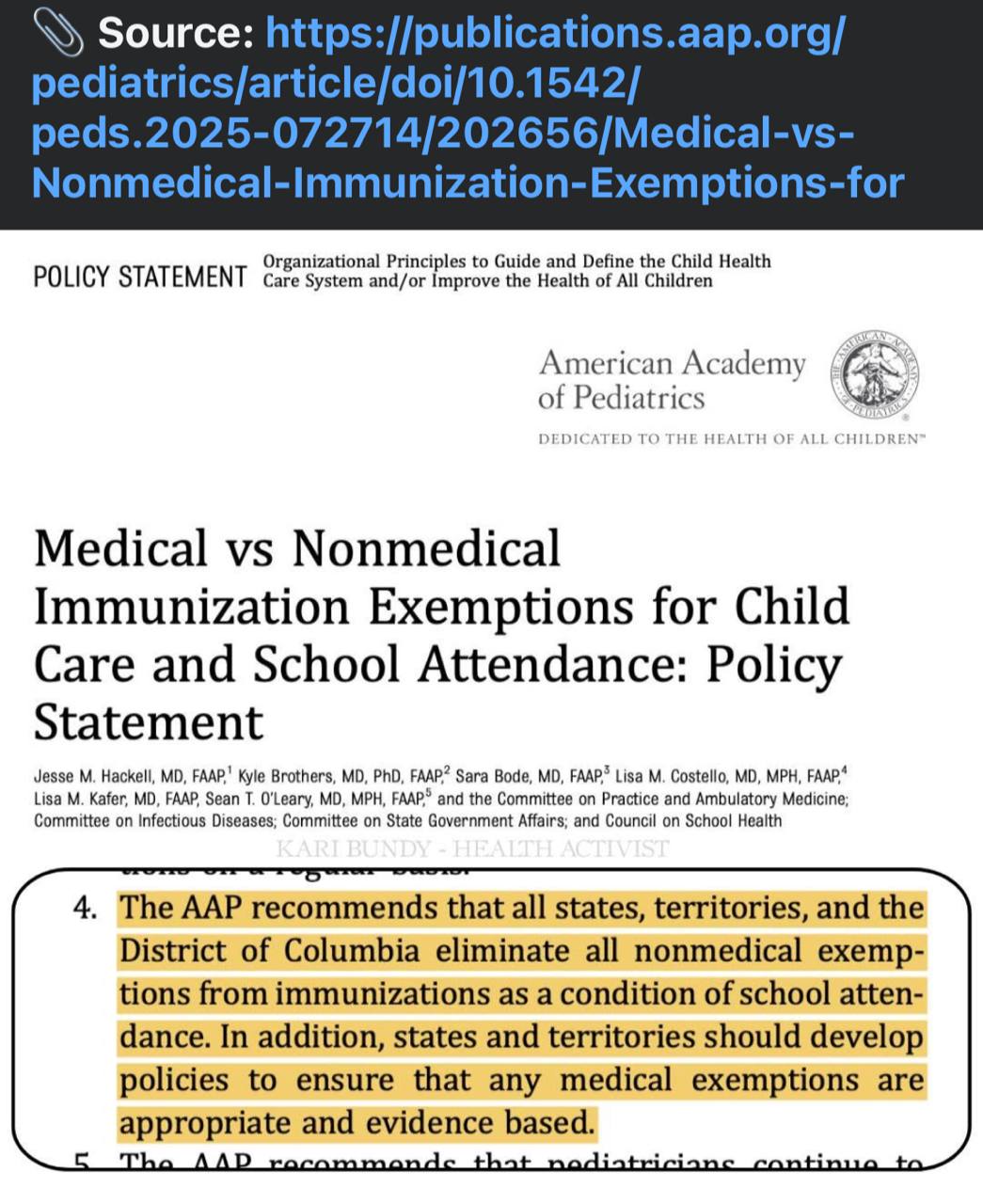
The American Academy of Pediatrics (AAP) has just issued a disturbing new policy statement calling on all states, territories, and Washington D.C. to eliminate ALL non-medical vaccine exemptions— including those based on religion, conscience, or personal belief. In their words:
“The AAP recommends that all states, territories, and the District of Columbia eliminate all nonmedical exemptions from immunizations as a condition of school attendance.”
Let’s be clear: this is an open assault on fundamental American freedoms.
The AAP is not just pushing vaccines—they’re pushing complete and total submission to state medical authority, erasing the right to dissent.
They openly argue that personal belief exemptions are "ethically problematic" and claim that exercising religious freedom or informed refusal creates “unnecessary risk.”
This is medical authoritarianism, plain and simple.
We live in a country founded on freedom of thought, freedom of religion, and bodily autonomy.
Now the AAP wants to label anyone who exercises those rights as a threat to society—and to bar their children from education unless they comply with a government-mandated pharmaceutical schedule.
No matter where you stand on vaccines, every American should be alarmed by this attempt to erase deeply held beliefs and hand over total control of our children’s health decisions to the state.
RESIST THIS.
Stand for freedom.
Protect parental rights.
🇲🇽- Mexican Cartel Drone Operator seen stalking a Mexican Marine Convoy in Mazatlán.
This isn’t much of a surprise, Cartel members have reportedly been joining the Ukrainian Foreign Legions en masse to hone drone operation and close quarters combat skills.
Since many of them are starting to return home, and now training other members of their cartels, i wouldn’t be shocked to see a new level of militarization in these organizations.
My jaw literally dropped listening to this
There is a Muslim pilot who works for United Airlines that regularly makes pro-terrorist organizations posts on his social media
The Muslims name is Ibrahim Mossallam. He works on the Board of CAIR New York, which is linked to the Muslim Brotherhood
He made an October 7, 2023 Facebook post calling the Hamas attacks “resistance by a brave people.” United suspended him with pay while investigating but the Pilots Union got him his job back and he went back to flying planes in America
Since then the pilot has been temporarily resuspended for flying because of his extreme religious beliefs and posts but he is 100% still employed. He is still getting paid on suspension
I looked into this guy and he is VERY involved in Muslim organizations
- CAIR-NY lists him as Board Vice-President and describes him as a professional international airline pilot who is “very active in shaping the Muslim youth community.”
- He has also been listed as a board ...
From Nic Hulscher:
We found COVID “vaccine” genetic code FUSED into chromosome 19 of a Stage IV turbo cancer victim.
This is the first peer-reviewed study showing that COVID shot DNA can integrate into the human genome.
Human beings should NOT have Pfizer or Moderna DNA in their tumors.
Study Link: https://ijirms.in/index.php/ijirms/article/view/2130
Follow @zeeemedia
Website | X | Instagram | Rumble
BREAKING: James Talarico Was in Ohio Mental Health Hospital During Mysterious Disappearance (AUDIO)
https://www.thegatewaypundit.com/2026/10/breaking-james-talarico-was-ohio-mental-health-facility/
HUH? Mental Hospital Denies Talarico Received Treatment After Claiming They Would “Never Disclose, Confirm, or Deny Who Our Patients Are Here”
https://www.thegatewaypundit.com/2026/10/update-mental-hospital-claims-talarico-has-never-received/