

We know what’s coming and we are prepared.

THE GRID WILL BREAK FIRST
By Shanaka Anslem Perera
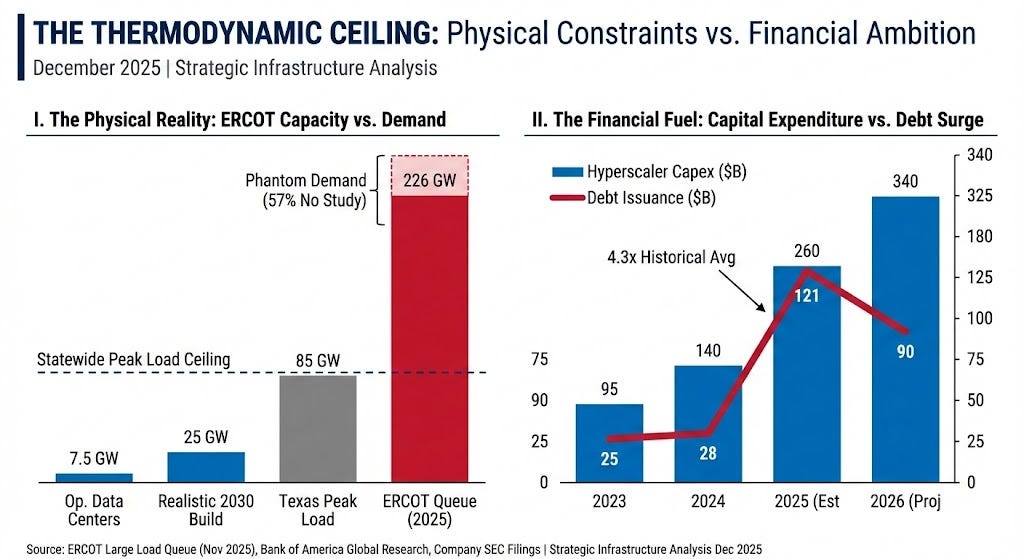
Texas just received requests for 226 gigawatts of data center power.
The entire state runs on 85 gigawatts.
Here is what nobody is telling you.
ERCOT's interconnection queue nearly quadrupled in twelve months. From 63 gigawatts in December 2024 to 226 gigawatts by November 2025. Seventy-three percent is data centers. The AI infrastructure buildout is now the largest in American history.
But here is the number that changes everything: 3%.
Of the 226 gigawatts requested, only 7.5 gigawatts are actually connected and operating. Fifty-seven percent of the queue has not even submitted planning studies. Joshua Rhodes at UT Austin called it "laughable." His estimate for what actually gets built by 2030? Twenty to thirty gigawatts. Ten percent of the queue.
The rest is vapor.
Meanwhile, Oracle just delayed OpenAI data centers from 2027 to 2028. The company carries $108 billion in debt. Negative $10 billion free cash flow. Credit default swaps at 126 to 141 basis points, the highest since 2020. And it owes OpenAI 4.5 gigawatts of capacity under a $300 billion contract.
OpenAI loses $9 billion per year. It must grow revenue fivefold in two years just to pay Oracle.
The circular financing everyone fears? We verified it. The $610 billion figure circulating through financial media is inflated tenfold. Actual executed investments: $63 to $70 billion. Still unprecedented. Still concentrated risk. But not the imminent collapse some predict.
The real constraint is not financial. It is physical.
Electrons cannot be printed. Transmission lines take a decade. Generation capacity takes five to seven years. The hyperscalers have the capital. They do not have the kilowatts.
This is not a bubble that pops. It is a ceiling that binds.
Data center vacancy: 1.9%. Pre-leasing: 84%. The demand is real.
The timeline to meet it is not.
Position accordingly.
Read the full article - https://open.substack.com/pub/shanakaanslemperera/p/226-gigawatts-of-nothing-the-physics?r=6p7b5o&utm_campaign=post&utm_medium=web&showWelcomeOnShare=true
NEW - Irish government runs an advert discouraging grandparents from hugging their grandchildren without consent.
@disclosetv
🇺🇸 Teenagers are now facing charges after doing a ding-dong ditch prank with a twist. They showed up in masks, wearing tactical gear and a rifle, or what looks like a rifle.
Two #Delaware teenagers, aged 16 and 17, faced charges after knocking on doors in New Castle while wearing tactical-style vests and carrying what appeared to be a rifle, police said.
This could’ve ended so badly..
Follow main channel -> LiveLeak
Follow private channel -> LiveLeak Private
🌆 Market News Digest
[Oct 21, 2026, 06:00–16:30 EST]
🔥 Top Stories
• Gulf tensions spike as U.S. orders Saudi embassy departures — Houthi drone attacks on Aramco/Shaybah, Iranian rhetoric, and evacuation alerts lifted oil-sensitive geopolitical risk
• Meta beats on revenue, unveils nonvoting stock plan — Q3 sales topped estimates, but a $9.9B legal charge crushed operating income as capex/AI spending stays huge
• OpenAI deepens Google Cloud partnership — Frontier models and Codex go onto Google Cloud Marketplace, a notable distribution win for Google and OpenAI
⛽ Oil & Energy
• Saudi Aramco/Shaybah attacked, but operations intact — air defenses intercepted a drone; no operational impact, yet the event kept crude elevated
• EIA crude stocks fall 3.06M barrels; gasoline drops 2.95M — bigger-than-expected draw, while diesel/distillate built
• WTI settles at $97.15; Brent at $108.82 — oil eased late despite supply fears; Kuwait says exports are at prewar levels
📊 Markets & Macro...

🌆 Market News Digest
[Oct 20, 2026 EST]
🔥 Top Stories
• US–Iran tensions swing markets — Hormuz tanker fire, Israel warns of renewed strikes, Rubio says talks are hard; oil stayed volatile even as Brent eased below $109
• Anthropic’s massive AI spend shock — WSJ says it may spend >$600B on compute, with huge cloud/Nvidia commitments and >$80B H1 loss
• Trump on Ukraine, Iran and trade — says Ukraine must make a deal, India trade is “pretty close,” and he’s weighing Iran action
⛽ Oil & Energy
• Hormuz tanker fire / mine incident — IRGC says a supertanker carrying >2M barrels caught fire after hitting a mine
• Europe gas >€90 — benchmark tops 2022 levels on supply fears; US diesel prices remain elevated
• NATO and EU security push — NATO adds Black Sea assets; EU doubles down on Arctic security and keeping fossil fuels in the ground
📊 Markets & Macro
• US housing weakens further — starts fell 5.2% and pending sales dropped 7.3% to a record low, pressuring ...