

We know what’s coming and we are prepared.

Oilprice.com
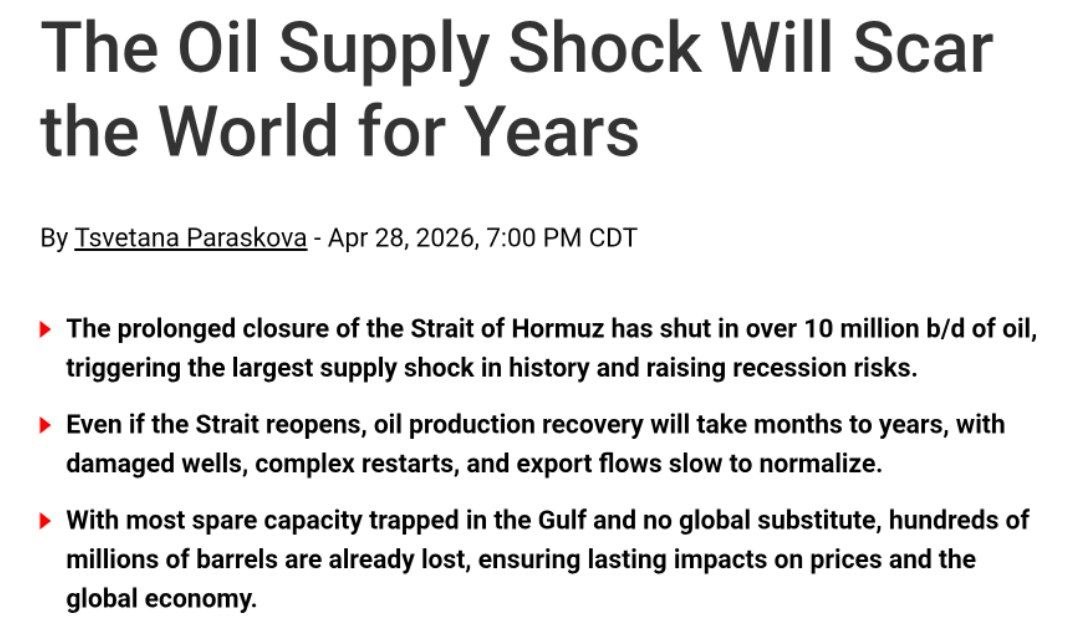
Two months after the U.S. and Israel bombed Iran on February 28, the Strait of Hormuz remains closed for most tanker traffic, forcing more than 10 million barrels per day (bpd) of crude output shut-ins across the Middle Eastern oil producers.
The two-month-long closure of the Strait of Hormuz is longer than analysts had expected at the start of the war. Most assumed back then that the Strait would open by April and producers could restart shut-in wells in May.
Even if the Strait of Hormuz opened to free tanker traffic today, oil supply from the Middle East will take months to start flowing again and reach consumers in Asia, who were the first to feel the supply shock.
The longer the chokepoint remains off limits to most tanker traffic, the worse the scars would be on global supply and economic growth.
The restart of thousands of oil wells across the Middle East would be a big challenge. Some countries would need weeks, but others – like Iraq – many months to bring wells back online, analysts and officials say.
Some wells may have been damaged, permanently, due to the hasty shut-ins in the early days of the war. Others will need new interventions and drilling to unclog, and output would not immediately return, even if the Strait of Hormuz is open unconditionally to all vessel traffic.
The oil market has lost hundreds of millions of barrels of crude since the war began. Losses are growing by the hour, and oil market participants may have finally caught up on the huge loss of supply that won’t be returning for months, even if the Strait of Hormuz reopened unconditionally today.
“In round numbers, the 1 billion [barrels] is baked in now because we have probably lost 600 million to 700 million at this stage, but by the time things get moving again, if they get moving again, it takes time to bring all back,” Vitol’s Hardy told the FT Commodities Global Summit.
🇺🇸 Teenagers are now facing charges after doing a ding-dong ditch prank with a twist. They showed up in masks, wearing tactical gear and a rifle, or what looks like a rifle.
Two #Delaware teenagers, aged 16 and 17, faced charges after knocking on doors in New Castle while wearing tactical-style vests and carrying what appeared to be a rifle, police said.
This could’ve ended so badly..
Follow main channel -> LiveLeak
Follow private channel -> LiveLeak Private

🌆 Market News Digest
[Oct 20, 2026 EST]
🔥 Top Stories
• US–Iran tensions swing markets — Hormuz tanker fire, Israel warns of renewed strikes, Rubio says talks are hard; oil stayed volatile even as Brent eased below $109
• Anthropic’s massive AI spend shock — WSJ says it may spend >$600B on compute, with huge cloud/Nvidia commitments and >$80B H1 loss
• Trump on Ukraine, Iran and trade — says Ukraine must make a deal, India trade is “pretty close,” and he’s weighing Iran action
⛽ Oil & Energy
• Hormuz tanker fire / mine incident — IRGC says a supertanker carrying >2M barrels caught fire after hitting a mine
• Europe gas >€90 — benchmark tops 2022 levels on supply fears; US diesel prices remain elevated
• NATO and EU security push — NATO adds Black Sea assets; EU doubles down on Arctic security and keeping fossil fuels in the ground
📊 Markets & Macro
• US housing weakens further — starts fell 5.2% and pending sales dropped 7.3% to a record low, pressuring ...
📝 🇪🇺 🇫🇷 Mario Nawfal on X: Europe's riots are just the beginning. The real economic shock hasn't even arrived yet.
I spoke with economist Philip Pilkington about the unrest spreading across France, Italy and Albania.
He thinks we're watching the early stages of something much bigger.
One statistic really caught my attention.
According to Pilkington, France's inflation-adjusted household food consumption has fallen roughly 6.4% since 2022. He suspects the poorest households have suffered far steeper cuts.
Now add another surge in energy prices.
Pilkington pointed to rice futures rising 70% this year, wheat and sugar climbing 40%, and fertilizer shortages threatening next year's harvest.
His prediction is that the worst food inflation could arrive this winter or next spring.
And there's a political problem sitting right on top of it.
Governments across Europe are already deeply unpopular. People are struggling to afford basic necessities, and another prolonged energy ...