

We know what’s coming and we are prepared.

🛢 JP Morgan: Oil Flash Note: The Illusion of Plenty
In this war-driven oil shock, inventories have become the market's primary balancing mechanism. Unlike a typical disruption where spare production capacity can be mobilized quickly, the location of the shock and the scale of the supply losses mean the immediate adjustment comes from barrels in storage. Inventories are acting as shock absorbers of the global oil system.
Of 8.4 billion barrels held in storage, 6.6 billion are onshore and 1.8 billion are offshore. Some of the offshore barrels are simply in transit from producers to customers, others — such as Russian or Iranian crude — effectively function as floating storage. By type, 5.2 billion are crude while 3.2 billion are refined products. Visibility varies wildly. OECD inventories are among the most transparent because member countries maintain strategic reserves, collect standardized data and publish timely statistics. Much of the world is less visible, particularly in developing countries. China is a notable exception where inventories are estimated to be around 1.3 billion barrels.
Finally it is important to distinguish between Strategic Petroleum Reserves — state-controlled emergency barrels — and commercial inventories which are privately held stocks used in normal course of trade and refining.
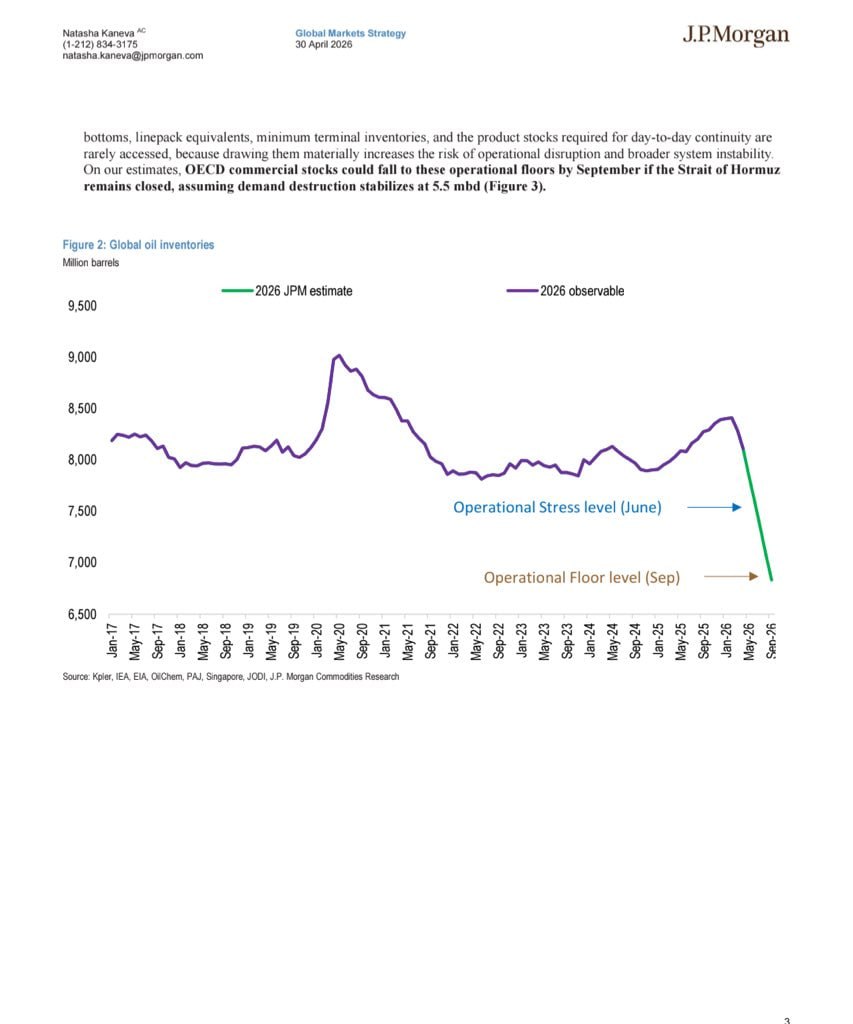
Even so, not every barrel can be withdrawn. Of the 8.4 billion barrels in storage, we believe that, realistically, only 0.8 billion barrels can be withdrawn without pushing the oil system into operational stress. As of April 23rd, roughly 280 million barrels have been consumed to cushion the impact of the 3rd Gulf War. On paper that suggests a comfortable buffer. In practice, the picture is more complicated. Floating storage can be tapped quickly but only a slice of onshore storage — around 580 million barrels — is readily accessible. The rest is effectively locked up in pipeline fills, minimum tank levels and other operational constraints.
This is why inventory floors matter. A market can hold millions of barrels and yet become fragile once working stocks fall too low. Like blood pressure in the human body, the issue is circulation. Pipelines lose flexibility, terminals cannot load efficiently, refiners struggle to secure the right grades on time and traders bid aggressively for the nearest supply. The system does not fail because oil disappears, it fails because the circulation network does not have enough working volume. Same principle applies to refined products.
In a prolonged disruption scenario, demand is rationed well before inventories approach critically low levels. In theory stocks can last much longer but only at the cost of reduced consumption, lower refinery runs and broader economic slowdown. As a result full drawdown of global oil inventories is unlikely.
Like an onion, oil inventory draws happen in layers. The sequence is determined by speed of access, economic cost, political willingness and logistical ease, not by who has the most barrels. The order is:
🔶 Oil-on-water and floating commercial stocks
🔶 Commercial onshore stocks
🔶 Strategic Petroleum Reserve
🔶 Demand destruction replaces inventory draws (the pivot)
🔶 Operational minimum stocks
OECD commercial stocks could fall to the operational minimum floor by September if the Strait of Hormuz is not reopened assuming demand destruction stabilizes at 5.5 mbd.
@CIG_telegram

If you missed it👇
Top AI Executives are now officially anticipating a large-scale event, most likely a cyberattack, that shuts down access to financial services, internet connectivity, and even power and water. We need to prepare for this scenario right now.
Watch here:
Follow @zeeemedia
Website | X | Instagram | Rumble