

We know what’s coming and we are prepared.

— 🇮🇱 It’s now 2026, a reality check for Israel after 3 years of war:
🇵🇸 Gaza front:
– Hamas has not been disarmed after almost three years of war.
– Tunnel infrastructure in Gaza is intact, rocket arrays being slowly rebuilt.
– Al-Qassam has approximately 25,000 fighters, the same amount as before Oct 7th.
– No sign of an interim government, Hamas is still politically in control of Gaza.
🇱🇧 Lebanon front:
– Hezbollah has not been disarmed, neither North nor South of the Litani.
– Hezbollah’s leadership has successfully reorganized and decentralized, and is now more resistant to assassination strikes than before.
– Hezbollah retains the capability to launch long-range and medium-range rockets, drones and missiles into Israel.
– The increasing use of FPV drones has rendered northern Israeli settlements into ghost towns, and significantly degraded the IDF’s freedom of movement in southern Lebanon.
🇮🇷 Iran front:
– The Islamic Republic is still firmly in power, and perhaps even more entrenched than before.
– Iran’s ballistic missile program, drone force, and conventional capabilities are almost entirely intact and capable of threatening Israel.
– Iran still possesses a large stockpile of highly-enriched uranium, nuclear breakout time is still at ~6 months to a year.
– The Strait of Hormuz is now under Iranian control.
– Most U.S. bases in the region have been rendered unusable and Israel’s Gulf allies are in the weakest position they’ve ever found themselves.
🇾🇪 Yemen front:
– Ansarallah (Houthis) still control the majority of Yemen.
– Houthis still possess hundreds of ballistic missiles and thousands of drones, capable of targeting Israel.
– The Bab Al-Mandab can be closed at any moment.
@Middle_East_Spectator
Scientists have now developed a way to genetically engineer lettuce with pig DNA to make plant-based meat taste like meat
The is a new 2026 study that inserted pig myoglobin genes into lettuce chloroplasts, which persisted in the lettuce grown from the harvested seeds. “This research follows the British company Moolec, which inserts pig DNA into soybeans to create what they call piggy soy”
‘Since this is all considered gene editing and not genetic modification, it bypasses most regulation and can be sold with little restrictions’
I have no words for how depraved the minds of these Christ-hating transhumanist idiots are.
Follow @zeeemedia
Website | X | Instagram | Rumble
“In every single dose of an MMR shot, there are literally, literally millions of pieces from the cultured cell line of an aborted fetus in every single injection.” — AARON SIRI
THIS IS WHY RELIGIOUS EXEMPTIONS MATTER.
Yet in states that have eliminated religious exemptions, parents can be forced to choose between violating their religious and ethical beliefs and their child’s ability to attend school.
🇺🇸Join👉 @SGTnewsNetwork
📎 X (Twitter)▪️Truth Social
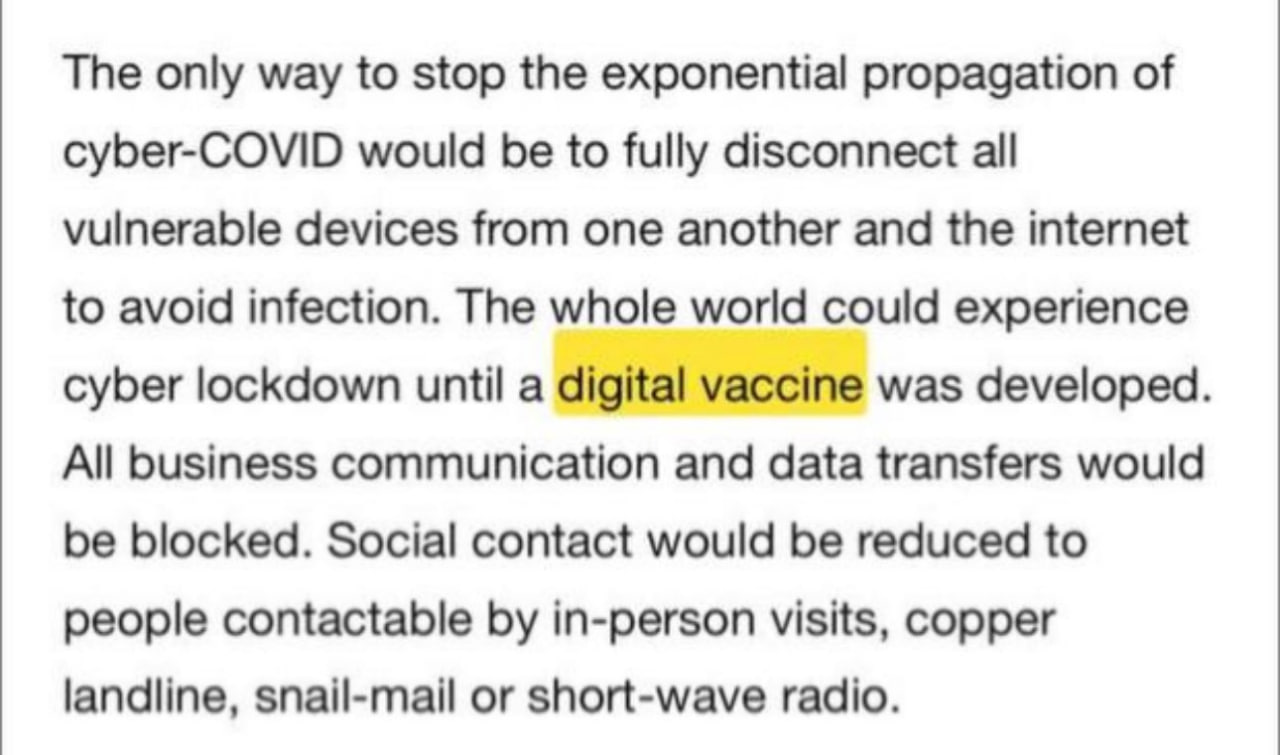
The WEF states that when a global cyber outage occurs from “Cyber COVID”, the whole world could (AKA will) go into cyber lockdown until a “digital vaccine” is developed.
This seems important to raise again when the tech lizards are screaming about an AI apocalypse in unison right now.
Follow @zeeemedia
Website | X | Instagram | Rumble
The Netherlands government has killed a 2-year-old baby, just one year after the country legalized euthanasia for children under 12.
In 2025, 10,341 people in the Netherlands were euthanized, up nearly 4% from the year before.
According to the Assessment Committee for Late Termination of Pregnancy and Termination of Life in Newborns and Children Aged 1 to 12 Years, the baby had "both mental and physical" disabilities, so they decided it was best to kill the child.
"The child had multiple, very severe disabilities, both mental and physical, and the prognosis was that the child would be dependent on support with all activities of daily living for the rest of their life."
After getting consent from the child's parents, the baby was killed.
https://nltimes.nl/2026/09/09/first-ever-case-euthanasia-young-child-2-handled-well-dutch-committee
Follow @zeeemedia
Website | X | Instagram | Rumble