
We know what’s coming and we are prepared.

A peer-reviewed paper published last year in the journal Bioethics by two professors at Western Michigan University School of Medicine argues that it is "morally obligatory" to genetically engineer ticks to spread alpha-gal syndrome, a permanent condition that makes you violently allergic to red meat.
The paper is called "Beneficial Bloodsucking."
Their argument: if eating meat is morally wrong, then preventing the spread of a disease that forces people to stop eating meat is also morally wrong. Scientists should gene-edit lone star ticks to enhance their ability to carry alpha-gal syndrome and expand their range into urban environments to infect more people.
They call this a "moral bioenhancer." They frame releasing genetically modified disease-carrying ticks as a "vaccination" that only "infringes" on your bodily autonomy rather than "violating" it. The distinction, apparently, is that a tick bit you instead of a government official holding you down.
Alpha-gal syndrome is not mild. The CDC estimates up to 450,000 Americans are already affected. Cases have surged 100-fold in the last decade. Symptoms include anaphylaxis. There is no cure.
Alpha-gal cases are exploding across the United States. The lone star tick's range is expanding far beyond its historical territory. And two academics at a medical school published a paper arguing this is a good thing that should be accelerated.
At what point do we stop treating papers like this as fringe academic exercises and start asking whether anyone is already acting on them?

Reposting - It’s fashion week again:
They’re not just celebrities.
They’re vessels.
What you’re seeing is not fashion, it’s a ritual. A manifestation.
These grotesque outfits and lifeless faces aren’t random.
They’re symptoms of something deeper:
a mental parasite expressing itself through human bodies.
This parasite has no soul, no gender, no form.
It cannot exist alone, it needs a host.
And once it enters, it hijacks.
It speaks through you. Thinks through you. Dresses through you.
That’s what’s happening in front of our eyes.
Pop culture, fashion, “trends”…
They’re not human creations.
They’re tools of mass programming, designed to make you mimic the parasite until it fully replaces you.
These scripted realities, your idols, your influencers, they’re just vessels. Empty dishes.
Hosts for an agenda that is not human.
Be careful what you admire.
Be careful what you wear.
Learn the patterns. Learn the programming.
Because the ones pulling the strings are ...
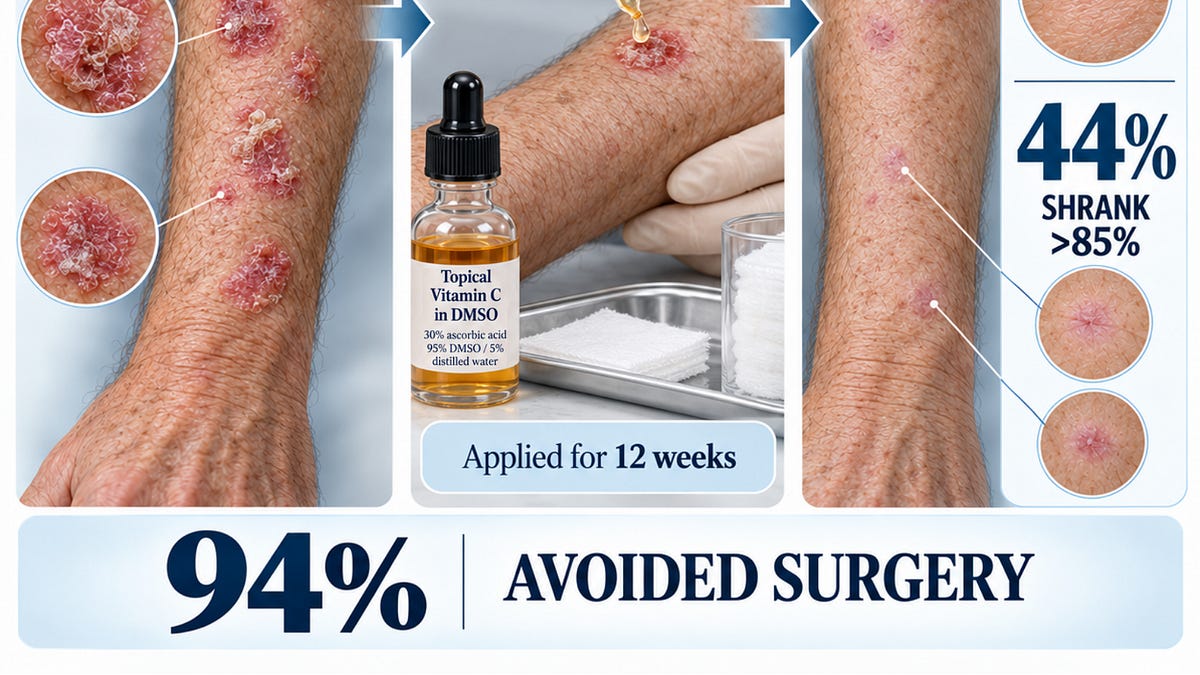
NEW STUDY: Topical vitamin C in DMSO completely ELIMINATED 56% of biopsy-confirmed skin cancers in just 12 weeks.
44% of the squamous cell carcinoma lesions SHRANK by over 85%.
94% of patients were able to AVOID surgery.
The average cancer lesion size dropped 71%.
The treatment was 30% ascorbic acid in a 95% DMSO/5% distilled-water solution, applied twice daily for 12 weeks.
DMSO was used as a skin-penetration enhancer, helping the vitamin C pass through the outer skin barrier and reach the lesion more effectively.
https://www.thefocalpoints.com/p/study-topical-vitamin-c-in-dmso-eliminated
Follow @zeeemedia
Website | X | Instagram | Rumble