

We know what’s coming and we are prepared.

🗳 🇪🇺 📵 Hyperdemocratic European Parliament reimposes mass electronic surveillance regulation after a majority votes it down three times
An extension of the European Union’s mass surveillance regulation known as Chat Control 1.0 failed to make it out of the European Parliament twice in March. Unable to summon a clear parliamentary majority, advocates (mostly in the centre-right European People’s Party [EPP]) turned to the European Council, which adopted the failed Chat Control 1.0 renewal on 2 July.
The Council’s position hardens automatically into law unless the European Parliament can summon an absolute majority to stop it. To forestall any such majority from forming, the EPP on Tuesday moved with member state backing for urgent procedure, angling to force their scheme through in the last days before the summer holiday, after many MEP’s had already left. The parliament narrowly approved the urgent procedure, and in consequence there were not enough votes to stop Chat Control 1.0 when it came for a vote today. Hours ago, a majority of 314 MEPs voted to stop Chat Control against the wishes of the Council, while a minority of 276 voted to let it happen. Because 314 is less than the absolute majority of 361, Chat Control 1.0 passed even though most MEPs present didn’t want it to.
It was a sleazy vote, not least because it’s far from clear this procedural manoeuvre was even appropriate in this case. Also, electronic surveillance is bad, but if we are honest with ourselves this battle was already lost.
Chat Control 1.0 was first instated in 2021 as a temporary exemption to the ePrivacy Directive of the EU, allowing messaging services and online platforms to scan chats and other electronic communications for child sexual abuse material. The exemption expired in April, but various platforms have continued their surveillance with no legal basis in the intervening months. Now their formal permission to scan our private communications has been restored and extended through April 2028. We are, in other words, merely returning to the prior regime.
Chat Control 1.0 is a temporary stopgap while the European Parliament, the Commission and the Council try to negotiate their Child Sexual Abuse Regulation, or Chat Control 2.0. As envisioned by the Commission, this permanent law would not merely allow platforms to scan private communications for child sex abuse material, but require them to do so; require additional AI-assisted automated scanning not only for known child pornography but also for such vaguely defined activities as “grooming”; and extend scanning to end-to-end encrypted services like Signal via mandatory monitoring on the client side. This insane proposal has been watered down over the years, in large part because of parliamentary opposition, but it’s coming in some form. We’re getting Chat Control 2.0 before Chat Control 1.0 expires, and Chat Control 2.0 will be at least somewhat worse.
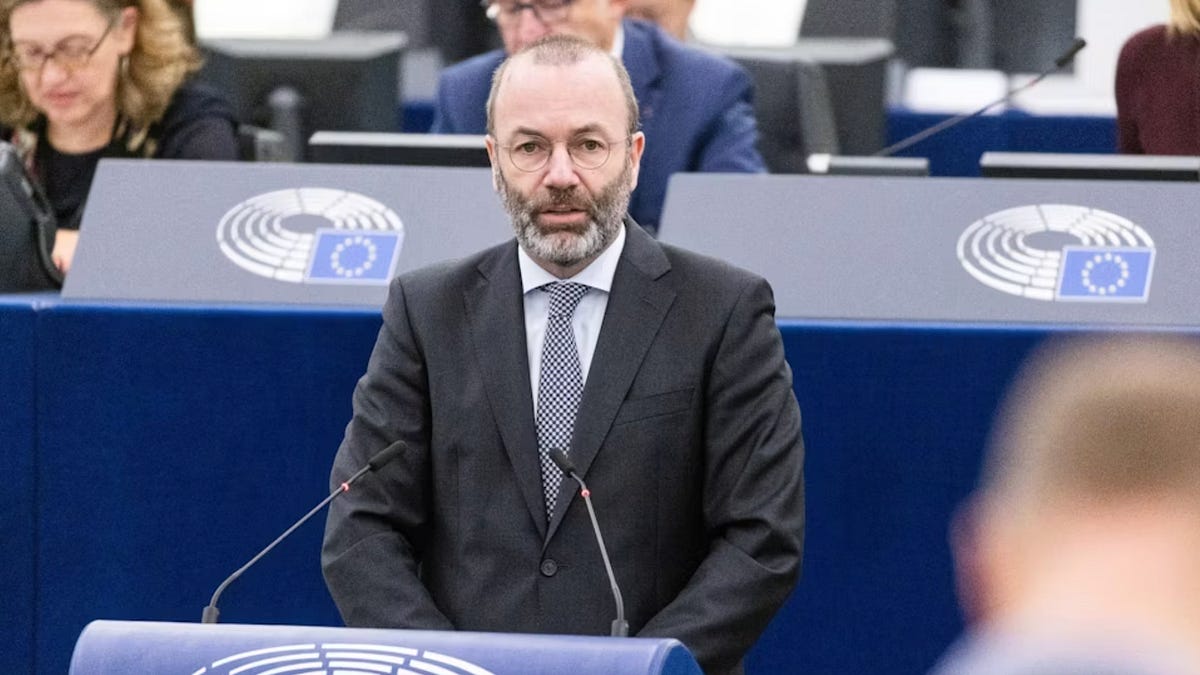
What’s amazing to me about all of this is this man:
His name is Manfred Weber, and he’s a Bavarian politician (CSU) who also happens to be president of the pro-surveillance EPP and leader of the EPP faction in the European Parliament. Weber loves electronic surveillance and he has been the driving force behind Chat Control from the beginning. Naturally, Chat Control is something that Weber would have a lot of trouble imposing in Germany, where surveillance is widely deplored and where our Basic Law guarantees as “inviolable” the so-called Briefgeheimnis – “the privacy of correspondence, posts and telecommunications.”
From his perch in the European Parliament, however, he has been able to hollow out this core constitutional principle of the Federal Republic from a procedurally rigged vote in Strasbourg, without any domestic debate or anybody in the Bundestag having a single thing to say about it.
This is a very advanced novel form of democracy that we have achieved here in the European Union.
🔗 https://www.eugyppius.com/p/hyperdemocratic-european-parliament
🇲🇽- Mexican Cartel Drone Operator seen stalking a Mexican Marine Convoy in Mazatlán.
This isn’t much of a surprise, Cartel members have reportedly been joining the Ukrainian Foreign Legions en masse to hone drone operation and close quarters combat skills.
Since many of them are starting to return home, and now training other members of their cartels, i wouldn’t be shocked to see a new level of militarization in these organizations.
📝 🇪🇺 🇫🇷 Mario Nawfal on X: Europe's riots are just the beginning. The real economic shock hasn't even arrived yet.
I spoke with economist Philip Pilkington about the unrest spreading across France, Italy and Albania.
He thinks we're watching the early stages of something much bigger.
One statistic really caught my attention.
According to Pilkington, France's inflation-adjusted household food consumption has fallen roughly 6.4% since 2022. He suspects the poorest households have suffered far steeper cuts.
Now add another surge in energy prices.
Pilkington pointed to rice futures rising 70% this year, wheat and sugar climbing 40%, and fertilizer shortages threatening next year's harvest.
His prediction is that the worst food inflation could arrive this winter or next spring.
And there's a political problem sitting right on top of it.
Governments across Europe are already deeply unpopular. People are struggling to afford basic necessities, and another prolonged energy ...
🇨🇦🇨🇦🗳 Alberta votes on leaving Canada; separatist movement likely to outlast expected defeat
Alberta holds a nonbinding referendum on Monday on whether the western province should secede from Canada, a debate many believe will not be settled by what is widely expected to be a defeat for the separatist cause.
Polls have consistently shown that a majority of Alberta voters oppose splitting from Canada. Economic grievances have fueled the independence campaign in the province, which is home to 5 million people and slightly smaller than Texas despite having one-sixth the population.
The Alberta separatist movement adds to the pressures on Canadian Prime Minister Mark Carney, who has made defending Canada's sovereignty a central mission as he confronts US tariffs and President Donald Trump's repeated calls for Canada to become the 51st state.
Many Alberta separatists believe the Liberal Party-led federal government in Ottawa has constrained the Conservative-governed ...
My jaw literally dropped listening to this
There is a Muslim pilot who works for United Airlines that regularly makes pro-terrorist organizations posts on his social media
The Muslims name is Ibrahim Mossallam. He works on the Board of CAIR New York, which is linked to the Muslim Brotherhood
He made an October 7, 2023 Facebook post calling the Hamas attacks “resistance by a brave people.” United suspended him with pay while investigating but the Pilots Union got him his job back and he went back to flying planes in America
Since then the pilot has been temporarily resuspended for flying because of his extreme religious beliefs and posts but he is 100% still employed. He is still getting paid on suspension
I looked into this guy and he is VERY involved in Muslim organizations
- CAIR-NY lists him as Board Vice-President and describes him as a professional international airline pilot who is “very active in shaping the Muslim youth community.”
- He has also been listed as a board ...