

We know what’s coming and we are prepared.

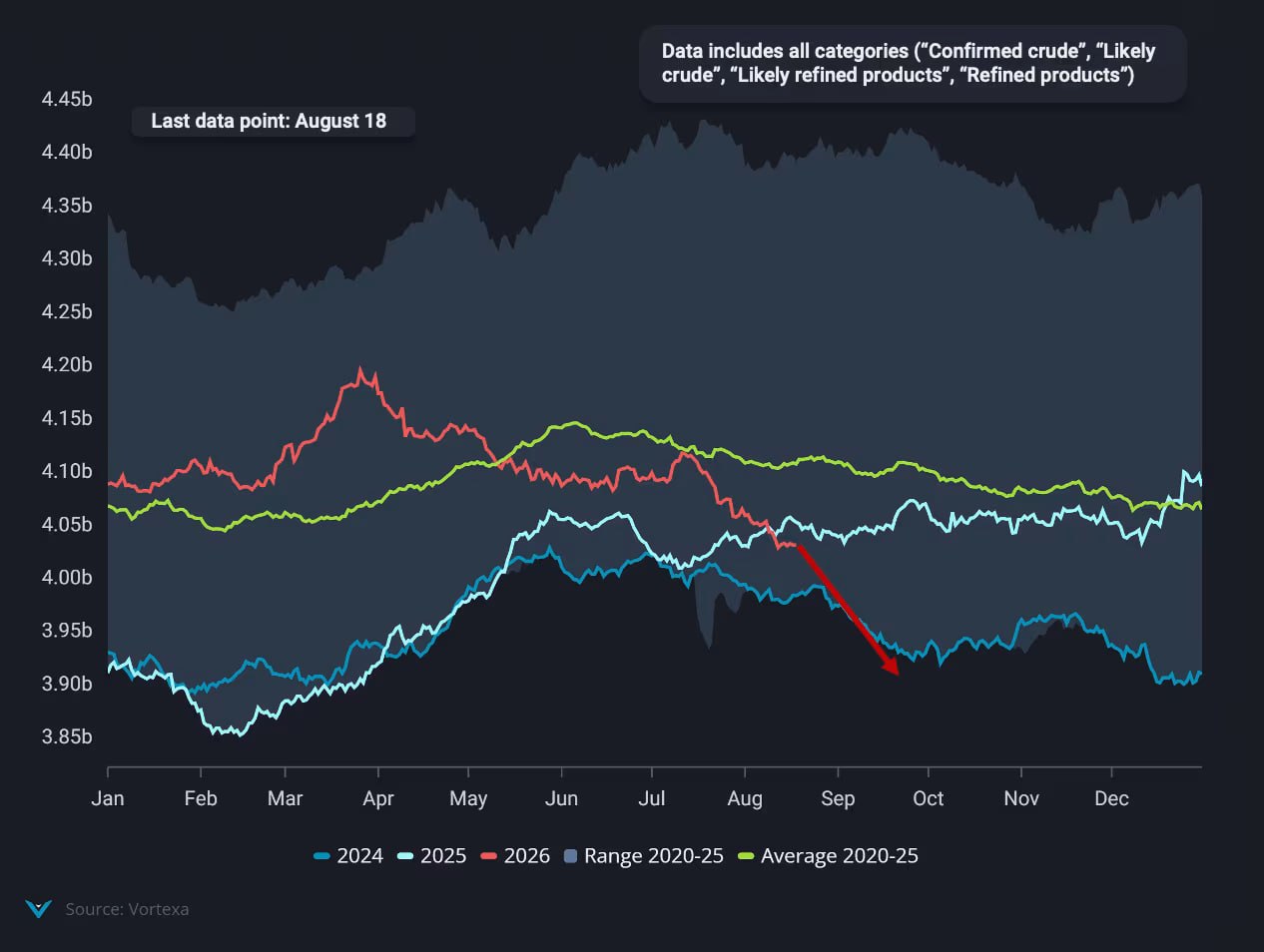
🛢 Global crude markets that looked well-supplied in July are now facing an impending supply tightness and the market is still underpricing shortfall
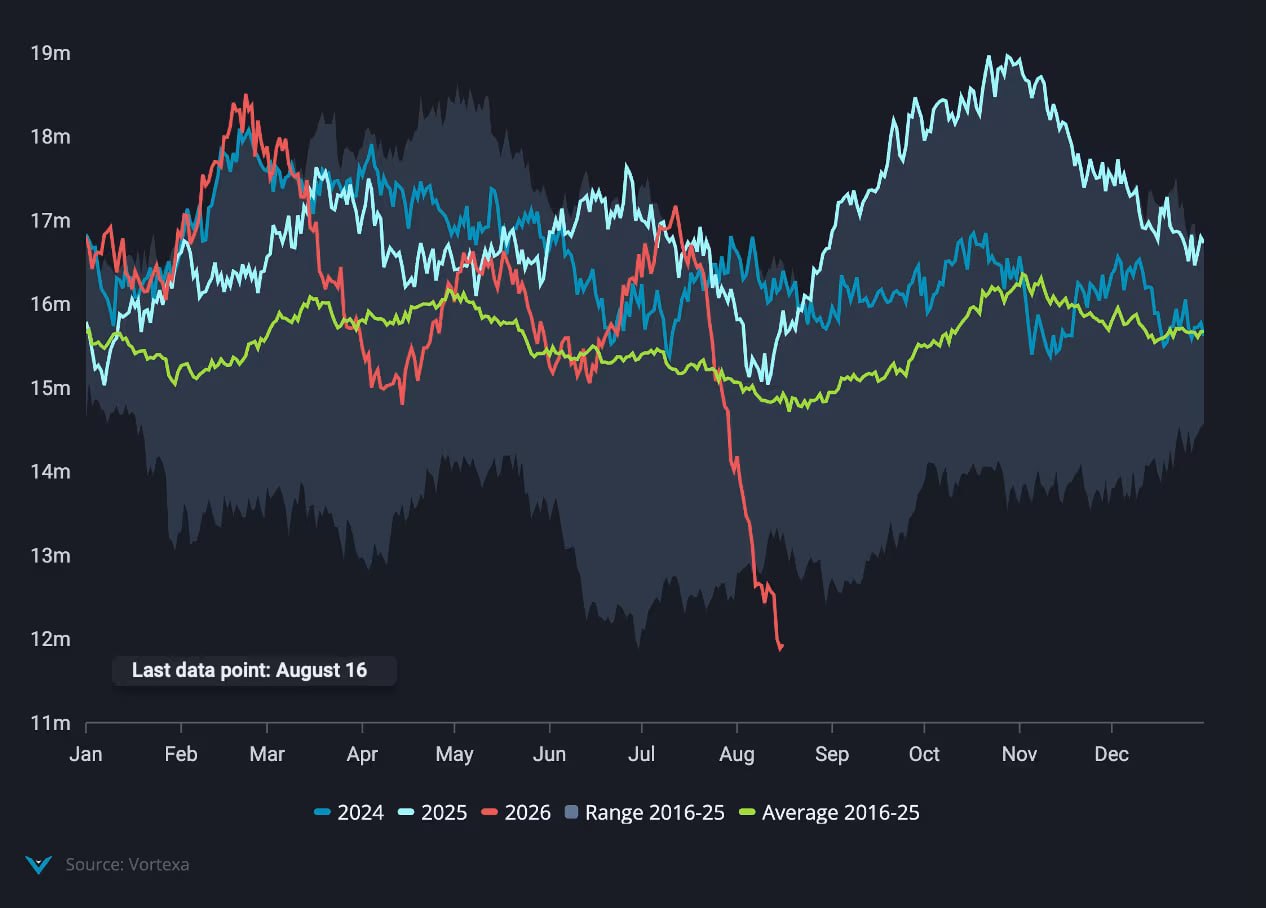
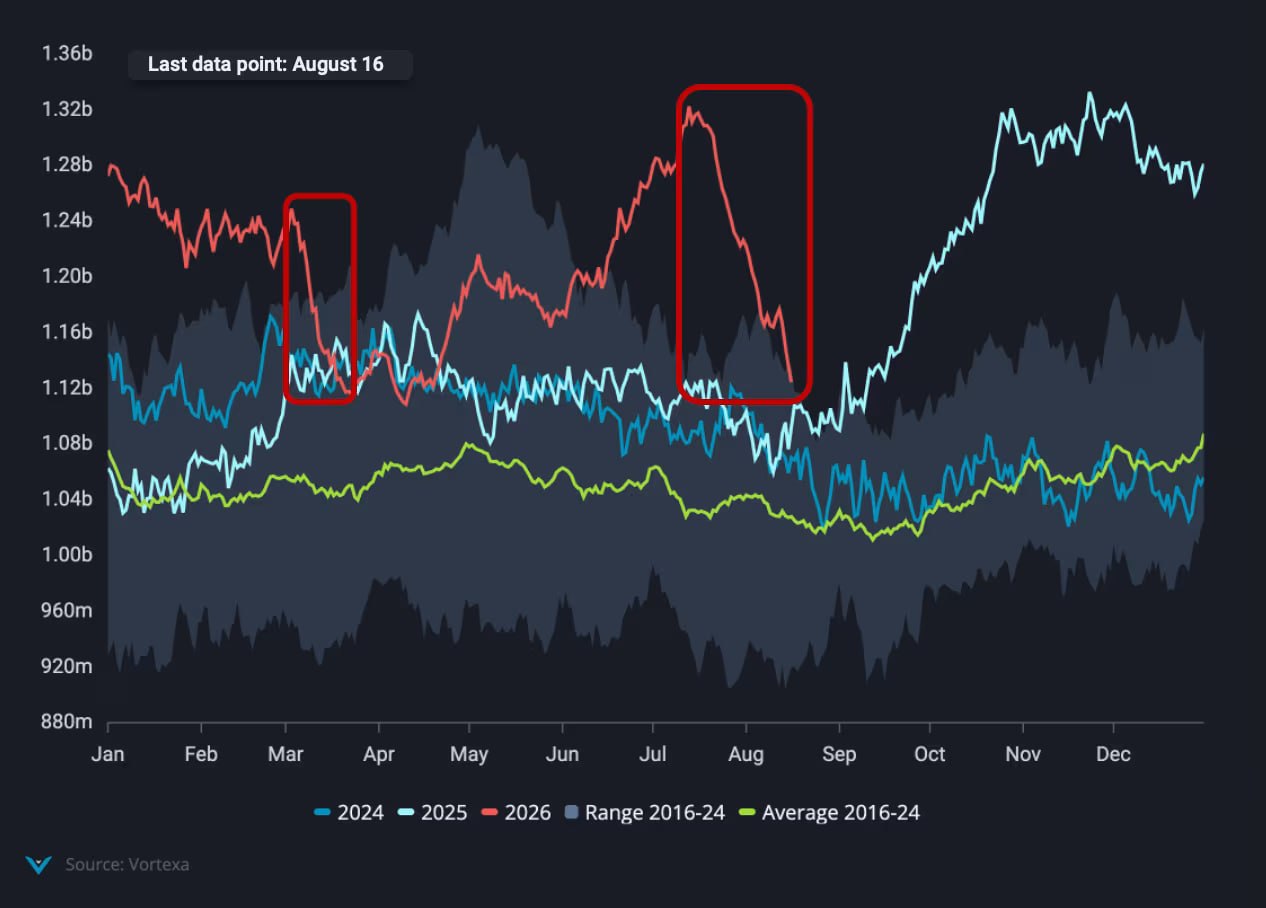
For a brief window in mid-July, global crude markets looked well-supplied. After the US-Iran MoU was signed on June 17th, Hormuz transits picked up, Iran also managed to get barrels on the water, and Atlantic Basin exports hit record highs. Crude and condensates on water climbed above ~1.3 bn barrels by July 13th — matching the post-Covid, post-price-war peak of Q2 2020. It was, in hindsight, a false dawn.
Since that peak, Vortexa data shows a collapse in crude on the water of ~200mb in just four weeks — a draw rate of 7.1mbd. To put that in context: the equivalent draw in the four weeks after the Middle East war began in early March was 102mb. This most recent drawdown is 95% larger, and the market appears to have barely noticed. Summer trading lulls, seasonally lower price volatility, and the brief sense of comfort created by the July peak may have dulled the market's sensitivity to what the physical data is now pointing towards.
The immediate driver of the drawdown is a simultaneous collapse in exports from four of the world's most significant crude exporters. Combined seaborne exports from Iran, Russia (including Kazakh transit grades), Saudi Arabia, and the United States fell to approximately 12mbd — a record low, and a 5mbd drop from just one month prior. Relative to the pre-war February peak, the four-country aggregate is down ~6.7mbd on a four-week moving average basis.
Iranian exports fell to near zero following the re-imposition of the US blockade outside the Strait of Hormuz after the MoU collapsed in mid-July. Saudi exports dropped as both Hormuz and Bab el-Mandeb escalated — with Houthi threats intensifying and vessel availability into the Red Sea port of Yanbu reportedly constrained. Russian and Kazakh export flows continue to suffer from recurring Ukrainian drone attacks on Black Sea shipping and pipeline infrastructure. And US exports eased as SPR releases tapered, peak domestic refinery runs cut into exportable surplus, and arbitrage economics temporarily closed the Atlantic-to-Asia window.
🔗 https://www.vortexa.com/insights/crude-markets-underpricing-an-impending
🇺🇸 Teenagers are now facing charges after doing a ding-dong ditch prank with a twist. They showed up in masks, wearing tactical gear and a rifle, or what looks like a rifle.
Two #Delaware teenagers, aged 16 and 17, faced charges after knocking on doors in New Castle while wearing tactical-style vests and carrying what appeared to be a rifle, police said.
This could’ve ended so badly..
Follow main channel -> LiveLeak
Follow private channel -> LiveLeak Private

🌆 Market News Digest
[Oct 20, 2026 EST]
🔥 Top Stories
• US–Iran tensions swing markets — Hormuz tanker fire, Israel warns of renewed strikes, Rubio says talks are hard; oil stayed volatile even as Brent eased below $109
• Anthropic’s massive AI spend shock — WSJ says it may spend >$600B on compute, with huge cloud/Nvidia commitments and >$80B H1 loss
• Trump on Ukraine, Iran and trade — says Ukraine must make a deal, India trade is “pretty close,” and he’s weighing Iran action
⛽ Oil & Energy
• Hormuz tanker fire / mine incident — IRGC says a supertanker carrying >2M barrels caught fire after hitting a mine
• Europe gas >€90 — benchmark tops 2022 levels on supply fears; US diesel prices remain elevated
• NATO and EU security push — NATO adds Black Sea assets; EU doubles down on Arctic security and keeping fossil fuels in the ground
📊 Markets & Macro
• US housing weakens further — starts fell 5.2% and pending sales dropped 7.3% to a record low, pressuring ...
📝 🇪🇺 🇫🇷 Mario Nawfal on X: Europe's riots are just the beginning. The real economic shock hasn't even arrived yet.
I spoke with economist Philip Pilkington about the unrest spreading across France, Italy and Albania.
He thinks we're watching the early stages of something much bigger.
One statistic really caught my attention.
According to Pilkington, France's inflation-adjusted household food consumption has fallen roughly 6.4% since 2022. He suspects the poorest households have suffered far steeper cuts.
Now add another surge in energy prices.
Pilkington pointed to rice futures rising 70% this year, wheat and sugar climbing 40%, and fertilizer shortages threatening next year's harvest.
His prediction is that the worst food inflation could arrive this winter or next spring.
And there's a political problem sitting right on top of it.
Governments across Europe are already deeply unpopular. People are struggling to afford basic necessities, and another prolonged energy ...