

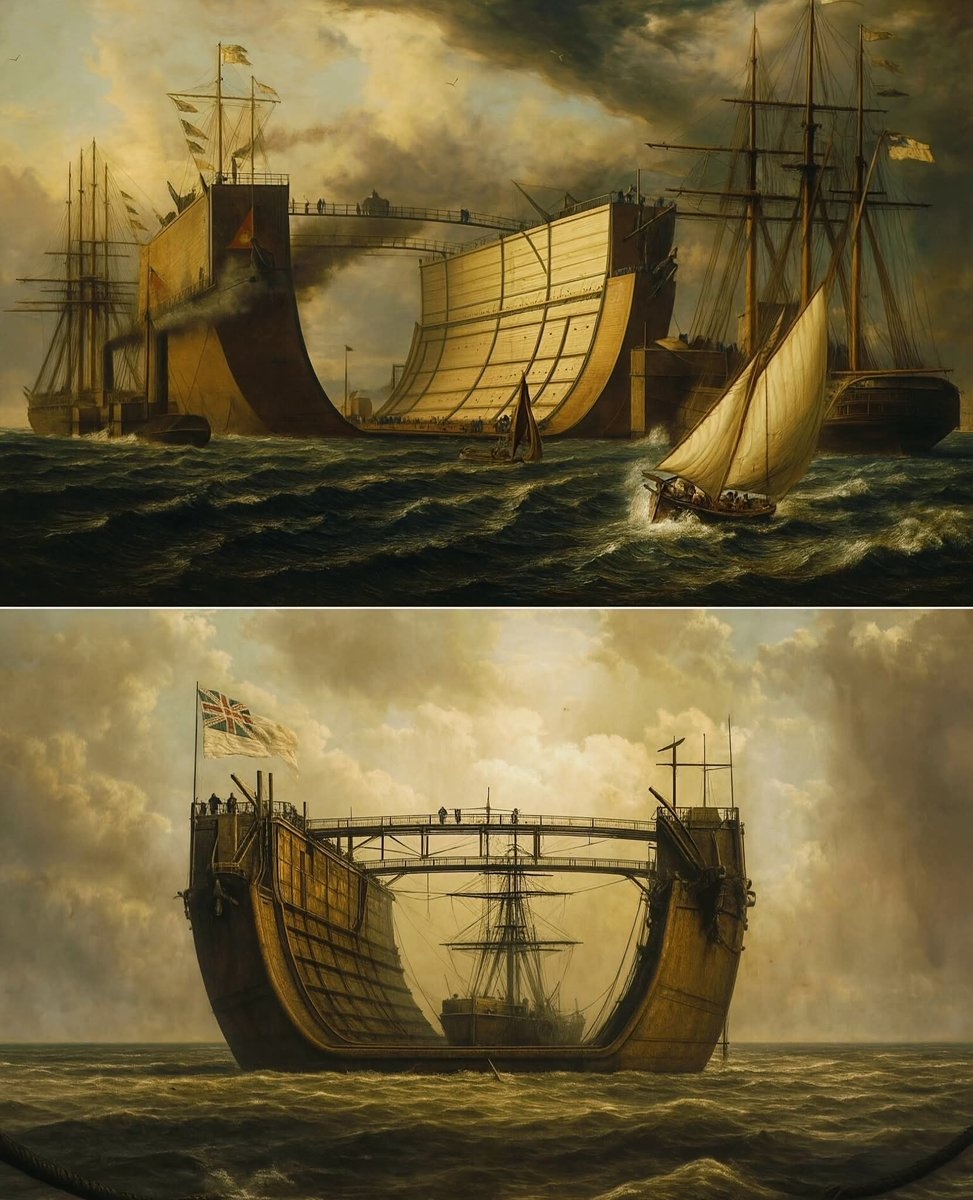
World’s Largest Floating Dry Dock Was Towed Across the Atlantic to Bermuda in 1869
When Britain needed a solution for ship repairs in the Atlantic, engineers built the largest floating dry dock ever attempted, a 380' iron structure weighing over 8K tons
Built near Woolwich on the Thames, the dock was designed to lift 10K-ton ironclads like HMS Warrior & w/stand Bermuda’s warm waters
Unable to build a conventional dry dock due to porous sandstone, the Brits opted for mobility&scale, creating a self-contained U-shaped platform that could sink&raise vessels from the sea w/ballast compartments & powerful pumps
In June 1869, the dock embarked on a 4K-nautical-mile journey to Bermuda, towed in stages by Britain’s heaviest ironclads—Agincourt, Northumberland, Warrior, & Black Prince—assisted by HMS Terrible
W/closed ends to reduce drag & a sail rigged inside to capture tailwinds, the voyage reached speeds of over 6 knots
Once in service, it supported Royal Navy ops for over 30 yrs before being replaced in 1906
🇸🇪 Sweden passes 'good behaviour' law to kick out misbehaving immigrants
Sweden's parliament passed a law on Monday allowing authorities to revoke immigrants' residency permits based on bad behaviour, such as having unpaid debts, doing undeclared work or links to extremist organisations.
The law, which covers pending permits but also retroactively already granted permits, is part of a wider tightening of immigration rules by the right-wing government and its support party, the nationalist Sweden Democrats, ahead of a parliamentary election in September.
The law has been criticised by the opposition and human rights advocacy groups as arbitrary because decisions would be taken on behaviour that has not been deemed criminal.
The law does not specify what types of behaviours are deemed unacceptable but the government has mentioned unpaid debts, not paying taxes, criminality and links to extremist organisations. The Migration Agency is tasked ...
The U.S. Strategic Petroleum Reserve (SPR) has fallen to 340.3 million barrels, its lowest level since 1983, after the government released another 8.9 million barrels last week.
The reserve has dropped 18% (75 million barrels) since the Iran conflict began in February.
The administration has used SPR releases to help keep oil prices from surging.
Source: CNN
After several hours of confusion and uncertainty, it’s time to bring some order to the situation.
What exactly did Trump agree to?
The agreement rests on two very lean principles:
“The Strait of Hormuz must remain open to free navigation, and Iran must not possess nuclear weapons.”
Trump has insisted in nearly every other post that Iran will not be allowed to obtain nuclear weapons, while simultaneously pushing to keep the Strait of Hormuz open to unrestricted maritime traffic at any cost.
But why was Trump so eager to reach such a minimal agreement? Why did he pressure Israel not to interfere, even at the cost of merging the various fronts and exposing soldiers to greater danger? Why did J.D. Vance, who has opposed military intervention, suddenly move to the forefront while Rubio faded into the background? And why has no one managed to offer a convincing explanation beyond references to the World Cup, birthdays, the midterm elections, and other superficial reasons for this apparent obsession?
Most ...